Showing posts with label French. Show all posts

Sunday, September 4, 2011

Vérité, Viewer, and Violence


Even though the option of shooting in colour was available as far back as 1908, throughout the history of cinema, filmmakers have reverted to black-and-white for myriad reasons. Hitchcock opted for it in Psycho (1960) because he believed the graphic violence depicted in the film would be too gory in colour. However, some critics believe the reasons were more practical than aesthetic—for instance, the difference between chocolate syrup (which was used in the much-celebrated shower scene) and blood is easily discernible in colour footage. There are still others, who are of the opinion the real reason behind shooting Psycho in monochrome was a tight budget. Ironically, it is colour that played a part in Scorsese deciding to film the gritty Raging Bull (1980) in black-and-white. It is said that when the British film director Michael Powell pointed out an anachronism—the boxing gloves being used was of the wrong tint—Scorsese chose to forsake hues altogether. Spielberg, on the other hand, followed the same logic as Hitchcock, while filming his Holocaust saga Schindler’s List (1993) in black-and-white. Evoking a sense of nostalgia might have contributed, too. 

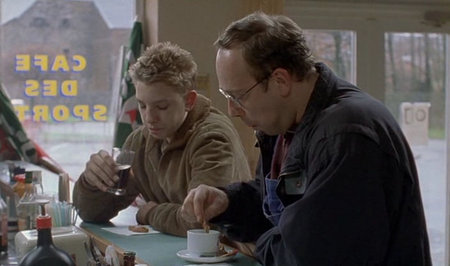
Aestheticity and authenticity aside, if there ever was a movie that needed to be made in monochrome, it, arguably, is the Belgian cult favourite Man Bites Dog (originally Cest arrivé près de chezvous, or It Happened in your Neighbourhood). Directed by three rookie filmmakers—Rémy Belvaux, André Bonzel, and Benoît Poelvoorde; who co-wrote the screenplay and also co-starred in the production, while working on a shoestring budget—it brings to the fore the darkest side of human nature and makes an incisive statement on our obsession with televised tragedy, all the while lacing the bitter message with a generous dollop of black humour.

Shot in cinema vérité style— Rémy, André, Benoît, and quite a few secondary characters retain their original first names in the film, to add to the authenticity—there is however, a subtle falsehood in the opening credit sequence. From the perspective of a train rushing through a tunnel, we are given a glimpse of light at the end. Unfortunately, those who will be able to withstand the audacious affront and stinging satire interwoven in almost every frame of this 93-minute-long exploration of voyeurism, there will be no metaphorical light once the film is over.

For, as Man Bites Dog—the title is derived from a journalistic aphorism of what constitutes news—progresses along its runtime, we, the viewer, are slowly but steadily pushed deeper and deeper into the murky world of Benoît, a serial killer, who is the subject of a documentary being produced by Rémy and his crew. No matter how improbable it might seem, in Benoît, we find a character who steals the thunder from the immensely infamous Hannibal Lecter, who had made his first appearance on celluloid just a year earlier. While Lecter was really terrifying, Benoît and his atrocities are terrifyingly real. 

To be frank, if our introduction to Benoît had been under different circumstances—within moments of appearing on screen, he drags a woman from the passageway of a moving train into his coupe and kills her with childish glee—we would have loved to hang around with him. After all, he does give the impression of a friendly guy with a goofy grin, who seems to know his F sharp from F natural; is equally at ease with topics that range from pioneering architects like Antoni Gaudi, Victor Horta, and Frank Lloyd Wright to expressionist painters such as Bernard Buffet and musicians like Charles Trenet; recites poetry impromptu; has an in-depth idea about the mating rituals of pigeons; can regale us by making any part of his body move on its own; and has an informed opinion on almost everything under the sun: from construction materials, man-woman relations, to movies starring the French actor Philippe Noiret.

Unlike most other serial-killer films that use the ploy of a mental malady like multiple personality disorder or at least offers a back story to explain the murderous trait being exhibited on screen, Man Bites Dog eschews any such ploys and makes it quite apparent that what we see in Benoît is what we get. Moreover, in contrast to others of his ilk, Benoît, a homophobic, xenophobic, racist individual who can ooze class in one moment and be utterly crass the other, is a compulsive exhibitionist, who grabs every opportunity that comes his way to reveal the tricks of his trade (for instance, the varied methods of ballasting a corpse to ensure that the body sinks and does not float when dumped into a stream) and basks in the warm glow of a sense of pride he feels in showing off as he smothers, shoots, and suffocates his ever-growing list of unfortunate victims.

One would be tempted to brand such an individual as a lunatic. But the manner in which he improvises his modus operandi (scaring an elderly woman to death by screaming at her, and thereby ‘saving one bullet’); the keen sense of observation he displays (realising that the aforementioned victim was a cardiac patient because he had immediately noticed a box of Sedocar: a drug for heart patients, in the room); the logic he provides behind going for the small fry (‘I work small and reap big’); and the unambiguous clarity he shows by asking the sound operator to bring the microphone closer so that the crunch of a neck being broken can be recorded on tape reveal that he clearly enjoys what he does and does not deny any sense of responsibility for his actions. 

While the portrayal of dastardly dealers of death on film are a dime a dozen, what elevates Man Bites Dog above the usual fare of serial killer flicks is that it makes the media—via the film crew following Benoît wherever he goes—and, as a corollary, us, the viewer, complicit in his actions. While we identify with the reluctance and trepidation that Rémy (the director of the documentary), André (the cameraman), and Patrick (the sound recordist) show when Benoît invites them for a seaside dinner after having mercilessly snuffed out another life, we also find us scurrying in our minds for the answer to a quiz question that Benoît poses to Rémy later on in the film.

As the participation of the director and his crew members gradually increases from shining the spotlight in a dark alley and changing over to the zoom lens to help Benoît locate another victim, to getting actively involved in the gangrape of a woman in front of her naked and terrified husband; to our utter horror, we discover that we, too, have been stripped of our sense of morality as we keep staring at the screen.

Winner of the International Critics’ Award at Cannes in 1992, Man Bites Dog asked several significant questions almost two decades ago that are all the more pertinent in today’s day and age of round-the-clock news channels and reality TV: What exactly is the definition of news? In their misplaced enthusiasm in getting the next ‘scoop’, is the media acting as a partner in crime? And, most importantly, are we, the viewer, influencing media or is it the other way round? 


Sunday, August 21, 2011

Illusion, Infatuation, and Ineptitude


From the opening sequence—an animated one—of his second feature film L’autre Monde (Black Heaven), where white snow flakes shower down from a jet black sky, French director-screenwriter Gilles Marchand makes it quite apparent that his film will deal with duality. As if to drive home the point, a platinum blonde appears on screen, dressed in black, whose strands of hair are in stark contrast to the dark cityscape. From intra-sequence contrast, the director then deftly segues to the next scene—set in a warm, sunny seashore in the south of France; as opposed to the cold, gloomy setting of the preceding one.

It is here that we meet the young protagonist of the film, Gaspard (Grégoire Leprince-Ringuet), his fiancée Marion (Pauline Etienne), and his two friends: Yann (Pierre Niney) and Ludo (Ali Marhyar). Frolicking in the sea, while jumping into the clear blue water, little do Gaspard and Marion know that soon they will find themselves knee-deep in murky waters. Inside a pool locker, the duo finds a cellphone. Their curiosity gets piqued when they pick up a call from the curiously named ‘Dragon’ and also take a look at a number of images stored inside the cellphone of a heavily mascara-ed blonde named Sam (Louise Bourgoin).

Deciding to play detective, Gaspard and Marion arrive at the place where Dragon had decided to meet Sam. They keep following the mysterious couple only to lose them at a quarry and rediscover them sometime later, trying to—what appears to be—carry out a suicide pact. While rescuing Sam, Gaspard also finds a DV camera, which, he surreptitiously slides into his pocket. 

At home, while watching the video recording, Gaspard finds himself slowly getting enamoured by the beguiling blonde, Sam. He also learns of an online game called ‘Black Hole’, which seems to hold the answers to a lot of questions about Sam, Dragon, and their partially botched suicide ceremony.  

After picking up the basics at a gaming zone, Gaspard buys a copy of ‘Black Hole’. Taking advantage of the anonymity that any such game provides, he decides to create an avatar for himself, named Gordon, which is diametrically opposite to him in real life. Slowly, but gradually, as he delves deeper into the virtual world of ‘Black Hole’ he starts picking up the tricks—how to survive and how to fight. A chance encounter with another character leads him to ‘Heaven’—a tall building that unsurprisingly touches the sky and is guarded by an all-seeing eye.

In the real world, by a quirk of fate, Gaspard meets Sam once again, only to find that she is called Audrey and has an over-protective brother named Vincent (Melvil Poupaud). In a perilous drag-racing sequence, involving an inebriated Ludo, Gaspard gets a glimpse of the violent streak in Vincent. Meanwhile, he is hopelessly attracted towards Audrey. Sourcing her out in ‘Black Hole’ he finds her avatar Sam is a singer. Under the guise of Gordon, he interacts more and more with Sam in the virtual world, who explains to him its ways. Gaspard is told that when a character dies in the ‘Black Hole’ s/he goes to a place called ‘purgatory’, from where it is extremely difficult to return but for which Sam has a particular fondness.

As Gaspard’s avatar finds himself bewitched by Sam, in real life he becomes more and more distant from both Marion and his two other friends. He even connives in the cyber universe to ensure that Audrey gets closer to him in the real world. Blinded by Sam’s lure, he is ignorant that there exists a truly dark side to the ‘Black Hole’. It is a game that its players use to have a fatal influence on other players in real life. 

L’autre Monde had all the ingredients to be a true ‘breakout’ film (it was screened at the breakout selection of the midnight section of Cannes in 2010). But towards the latter half, the film simply falls apart. What could have been a searing indictment of the isolation, anonymity, and deceit that are so often associated with the gaming culture ends up being a hackneyed effort at intermixing real life with virtual reality. It fails equally in treading new ground when it comes to depicting our age-old fascination with the unknown and the unattainable.

While both Marchand and his co screenwriter Dominik Moll should share the blame for allowing a promising storyline to peter off into triteness, a part of the fault also lies with the actors. Like the game itself—which bears an uncanny resemblance to ‘Afterlife’ and has a visual aesthetic reminiscent of ‘Tron’—the major characters are all good to look at but have very little substance. Louise Bourgoin’s character had the potential of cementing its place in the film firmament as a neo femme fatale. Unfortunately, the similarities only remained superficial. Similarly, even though it would have been easier for us to sympathise with the jilted Marion, some of the lines she mouths (a particular gem was: ‘There are two kinds of people. Some are nice, others aren’t’!) make one balk.

The biggest culprit has to be Leprince-Ringuet. Where Gaspard should have been multi-dimensional as a character, Leprince-Ringuet paints him in really broad strokes, much like the way Gaspard uses a paintbrush on the walls of his apartment’s hallway.

Like any online game, the success of a film that deals with one, should also hinge on its replayability. That is obviously not true for L’autre Monde. Even more ironical is the fact that as a film dealing with duality, it succeeds in making the virtual space of ‘Black Hole’ more real than the flesh-and-blood characters that inhabit its real world.

Sunday, July 31, 2011

Fate, Fascination, and Fortitude


The renowned British playwright Tom Stoppard had once remarked: ‘A movie camera is like having someone you have a crush on watching you from afar—you pretend it's not there.’ In Le Fils  a.k.a. The Son (2002), a film by the Belgian director-writer duo, brothers Jean-Pierre Dardenne and Luc Dardenne, the camera is more like the gaze of a smitten lover—unflinching and unwavering to the point of being almost unbearable.

With their grounding in documentary filmmaking, in the hands of the brothers, the camera seems to have taken a life of its own—prodding, prying, and perceiving the dreary, day-to-day dealings of Olivier (a role that fetched Olivier Gourmet, the perennial favourite of the Dardenne siblings, the Best Actor award at the 2002 Cannes Film Festival), a carpentry instructor at a vocational rehabilitation establishment in Liège, Belgium.
However, even though the Dardennes have filmed Le Fils using a handheld camera, their approach is not that of the ‘queasy-cam’; nor is it the point-of-view style, which is the current fad among filmmakers. Instead, the shots are mostly over-the-shoulder of Olivier, so that the camera sees what Olivier does, rather than acting as an expository element.
At the beginning of the film, during the few occasions that we get to see his face, we find the bespectacled Olivier to be an expressionless and sullen individual. Meticulous in his craft, as all good carpenters should be, he gruffly reprimands his four students—Raoul, Steve, Omar, and Philippo—whenever they fail to stick to the basic tenets of carpentry. The hammering of nails, whirring of power tools, and other ambient sounds of a carpentry workshop fill up our ears from the moment the film opens. To accentuate Olivier’s dull existence, the Dardennes have completely done away with a background score. It is as if to signify that like the unseen camera that hovers around his back or the wooden beams that he is sometimes seen balancing on his shoulder, Olivier is carrying a burden—a burden that has the potential to completely mess up the life of this otherwise careful, meticulous man.

While Olivier checks the measurements taken by his students, instructs them to plug gaps between pieces of wood, and shows them how to use the various tools of the trade, one gets the feeling that this ever-watchful individual is equally fastidious about not letting his guard down. One cannot but help think that the attention to detail is but a façade, cultivated to keep in place a secret simmering deep inside.

Always in motion, keeping his hands busy forever, Olivier’s continuous movement is quite akin to that of an animal in captivity. His only way of letting out steam is to do pushups within the confines of the four walls of his dingy apartment. But then again, that act might not be to alleviate the pain he feels deep within, but to soothe the muscles of his lower back.

A man who does not reveal an iota of emotion when his estranged wife arrives at his doorstep to tell him that she is getting remarried and is also carrying a child in her womb, suddenly springs to action when he is handed the file of a young boy, Francis (Morgan Marinne) who wants to join his carpentry section. Initially reluctant and dismissive, soon Olivier starts following Francis, both inside the vocational facility, and out of it. He steals his keys, breaks into his room, and even lies down on his bed. Little by little, we learn about the blow fate has dealt to Olivier. Slowly, but surely, we also fathom the reason behind the man’s growing fascination about who the boy is and what he does.

It is precisely then that every movement of this cautious carpenter takes on a completely different dimension. Contrary to the pre-determined method that determines how two pieces of wood fall in place, we, the viewer—now privy to Olivier’s secret—are left to wonder what the outcome of each of his moves will be. The total lack of any expository dialogue and the absence of any back story make the task all the more difficult for us.

Francis, though, is completely oblivious of how his life is connected to that of Olivier. This uneven equation is made even more apparent by the symmetry that is such an inherent aspect of the profession of carpentry. Francis is, however, in awe of Olivier’s acumen of using his eyes as a measuring tape. Even though Olivier is barely civil towards the sixteen-year-old—he refuses to pay for his food, nor does he shake his hand—an unspoken understanding starts growing between these two equally quiet individuals, step by step, in sync with the carpenter’s character.

Then, one day, Olivier extends an invitation to Francis to accompany him during the weekend on a long drive to a timber yard. The objective is to understand various types of wood, he says. But we, the viewer, because of what we know and Francis does not, fear for him. And we pray that for once this man, who has an innate ability to make the correct decision when it comes to a dead piece of wood, displays the same judgment in the case of life, as well.

A film that says as much with an actor’s body as one blow of a carpenter talks of his talent, Le Fils, while staying true to the ‘Belgian lower-class life’ template that the Dardenne brothers are famous for, has at its core a simple truth with universal appeal.  Inevitably, most of us will not miss the obvious comparison between Olivier and the most revered carpenter of all, but the essence of this truly minimalist film lies in the carpenter’s rule: ‘Measure twice; cut once.' 


Sunday, June 26, 2011

Injustice, Imprisonment, and Intent


Way back in the 1940s, inspired by the American film noir, the French developed a genre of crime thrillers of their own. They called it films policier. Just like the central character of noir is a morally ambiguous, skeptical, and disillusioned male; films policier, more often than not, revolves around a similar cynical male’s struggle against a stronger opponent. With time, like every other genre, films policier, too, has evolved and has even branched out into several sub-genres such as the daintily named polar (policier with a dash of mystery), neo-polar, and post-noir.

Recent French filmmakers, like Fred Cavayé, in his debut feature film Pour Elle (2008), a.k.a. Anything for Her, have added to the broad policier template by intermixing the thriller elements with an in-depth character study—that of a man on a mission against an act of injustice. The relentless ‘no-time-to-lose’ element that characterises a thriller is set in motion immediately with Pour Elle beginning to unfold even before the opening credits start flashing on the screen.

Divided into the classic three-act structure, the first of which is ‘The last three years’, the film introduces us to Julien Auclert (played by Vincent Lindon), a high-school French teacher, and his small family comprising his diabetic wife Lisa (Diane Kruger) and their toddler son Oscar (Lancelot Roch). Theirs is an idyllic life, which is turned on its head in an instant one morning when the police barge into their apartment and take Lisa into custody, on charges of murder—an accusation that astounds Lisa as much as it baffles Julien. Even though a detective is assigned to the case, and Julien believes wholeheartedly in Lisa’s innocence, as days pass by chances of Lisa’s acquittal become as distant as the mental gulf broadens between her and Oscar.

Then, the day of reckoning arrives. With not enough new evidence that could prove Lisa’s innocence, accompanied by the considerable amount of old evidence that was stacked against her, the lawyer informs the dumbfounded Julien that Lisa has been sentenced to twenty years in prison. With that pronouncement, the unassuming French teacher finds the flicker of hope that he had harboured for three long years get smothered.

Like any other common man, initially, Julien sees no other option but to accept the court’s verdict. But when news reaches that Lisa had attempted to commit suicide, he decides to take matters in his own hands and attempt the apparently impossible— snatch his wife from the clutches of law.

At this juncture, one would expect the evolution of an individual into a hero, armed with an outrageous plan and an arsenal at his disposal to boot. But Cavayé’s (he co-wrote the screenplay) protagonist is anything but an action hero. He is the quintessential ‘average man’, who, when facing extraordinary odds does not perform a volte-face character-wise, but reacts the way any other man-on-the-street would. And in this he is helped by Henri Pasquet (portrayed by Olivier Marchal, director of the superlative films policier of 2004, 36 Quai des Orfèvres)—an ex-convict who had escaped from prison as many as seven times, and is now the author of a bestselling book My Life on the Run.

While laying down the ground rules of engineering an escape from prison, Pasquet underlines the basic tenet: ‘Escaping is easy. The hard part is staying free’. He also warns Julien that those who do succeed in the attempt are born criminals. Since there is no chance of improvisation, others, like Julien himself, are advised not to walk that path simply because they will end up getting ‘burned bad’.

In the second act of the film, titled ‘The last three months’, we find that Julien has already progressed so far down the path Pasquet had warned him about that there is no turning back for him. Always distant from his father, he has now grown even more detached not only from him, but also from the other members of his family, including his brother Pascal (Thierry Godard) and even Oscar. His life now has only one focal point—that of trying to devise a plan of his own to get Lisa out of prison. Knowing fully well that he will not be able to share his secret with his pragmatic wife, Julien carries the burden quietly, not succumbing even when Lisa misinterprets his growing aloofness. Meanwhile, little Oscar tries in his own way to reach out to his Dad, by imitating his father’s actions, which mainly involves converting his apartment into an operations room, replete with maps, photos, newspaper clippings, graphs, schedules, and numerous notes. 

‘The last three days’ is the dénouement of Pour Elle when an unforeseen event threatens to jeopardise the plan that Julien had so meticulously drawn up over the past few months. Not only that, a violent act committed by him puts the police hot on his trail, which leads to an edge-of-the-seat climax.

Prison film itself is one of the most clichéd of all film genres. Within its sub-genres, wrongful imprisonment and planning an escape rank quite high. Pour Elle could easily have just been one more entry into this seemingly endless churning of old wine in an old bottle, but for one important difference. It emphasises more on the planner than the ingenuity of the plan itself.

In fact, in hindsight, irrespective of the time and effort that Julien spends on hatching a way to get Lisa out, his plot has nothing innovative in it. And this is exactly where those of us expecting an action-packed ‘rescue mission’ will be sorely disappointed. In all probability, this lack of action, except in the last quarter of an hour of the film, must have been the reason Hollywood decided to remake Pour Elle into The Next Three Days (2010), starring Russell Crowe and Elizabeth Banks in the lead, and directed by the Academy Award winning director and screenwriter Paul Haggis.

However, if one is not averse to shift focus in a film belonging to a done-to-death genre and ponder more on the psyche of an average-Joe, who wants to right the wrong done to someone he cares for not by transforming himself into a one-man army or masterminding a complex plot; or if one is open to a film where emotions are underplayed, reactions to adversity are subtle and not of the chest-thumping variety, and the protagonist is most of the time clueless of his next move than being a know-it-all—then Pour Elle is pour vous. 


Sunday, March 6, 2011

Magic, Materialism, and Melancholy


Paris. 1959. The vaudeville theatres of France find themselves in the middle of a losing battle against the proliferation of television, showy rock stars, and other new forms of entertainment. In such a fast-changing scenario, an elderly illusionist, Jacques Tatischeff, finds himself and his quaint art form as difficult to fit in, as he finds it hard to manage his mischievous little pet rabbit while pulling it out of the hat in front of an ever-diminishing audience. 

Undeterred, he decides to shift base and comes to London, where he takes up assignments at garden parties to make ends meet. But here, too, the only appreciation he gets while conjuring wine glasses out of thin air is from a Scottish guest, who is as full of liquor as the glasses in Tatischeff’s hand. On this inebriated individual’s invitation, Tatischeff arrives at a remote Gaelic-speaking island that has only recently been electrified. No wonder then, the villagers find switching a light bulb on and off and crowding around the jukebox as enthralling as any magic trick.

In the same inn where Tatischeff is lodged works Alice, a young girl entrusted with doing laundry and keeping the premises clean. To her impressionable mind, the illusionist’s performances in the pub are not sleight of hand, but true magic and Tatischeff, a mystical magician in the flesh. And when the elderly illusionist buys her a pair of new red shoes, to replace her old, tattered ones, Alice, like Dorothy of The Wizard of Oz decides to go on what she believes will be an equally magical journey. Only this time, rather than taking the yellow brick road, she follows Tatischeff and convinces him to pay Edinburgh, a land famous for its street performers and magicians, a visit.

Once in Edinburgh, the two of them put up at Little Joe’s Hotel—a rundown establishment, whose residents include a triplet of trapeze artists (an oblique reference to the same director’s equally adorable 2003 film The Triplets of Belleville), a down-on-his-luck anorexic mime, and an out-of-job ventriloquist—all of whom represent the microcosm of the slowly-dying traditional forms of entertainment.

As the young Alice slowly gives in to the lures of a big-city life, Tatischeff, egged on by the opportunity to redeem a missing piece in his own life, and unwilling to let go of the only audience he has who still seems to believe in magic, decides not to break the spell. He starts showering her with increasingly expensive gifts, while hiding from her his own struggles that force him to take up obscure jobs like working in a garage, painting billboards, and even working as a live demonstrator at a shop selling women’s perfume and undergarments. While Tatischeff regales the passersby from the store’s window, one day Alice finds love across the street, while peeking out of the window of her hotel room. The last vestige of magic seems to come to an abrupt halt in Tatischeff’s life, as he confronts the reality that life so stone-heartedly shoves in our faces.

Based on an unproduced script by the acclaimed French director and actor Jacques Tati (whose full-name was, in fact, Jacques Tatischeff) L’illusioniste (2010) is a double ode. Tati’s script, which he wrote in 1956, but never got around to depict on celluloid, was a thinly-veiled dedication to his daughter, who he had abandoned early in her life. In his L’illusioniste, director Sylvain Chomet has, in turn, paid his homage to the French master. In this sublime hand-drawn full-length animation film, which, incidentally was nominated at the recently-concluded 83rd Annual Academy Awards in the Best Animated Feature Film of the Year category, Chomet, while staying true in depicting Tatischeff in the physical likeness of Tati, has also carried forward Tati’s signature approach to film making that is known for being sparse in dialogue but rife in emotion.

Think of the dialogue-less but heart-wrenching initial sequence of Pixar’s Up (2009) extended to an eighty-minute run time that is buoyed by beatifically drawn characters who speak volumes through body language and a lilting musical score composed by Chomet himself, and one can have a preliminary idea of L’illusioniste. At the same time, it offers a sharp criticism of the consumerist society we live in and our preponderance to discard the old without so much as batting an eyelid. A tale of relationship that has shades of Chaplin’s brilliant Limelight (1952), it shows how all of us are in constant pursuit of one illusion or the other, while ironically, those who pursue conjuring illusions as a trade lie long-forgotten.

When all of us hanker after a little magic in our lives, it is indeed tragic that circumstances can compel a professional illusionist to forsake his art in the face of cold reality. That the curtain has fallen, in particular, on the kind of magic that Tatischeff and his compatriots once plied, and in general, on vaudeville music halls is immaculately depicted by Chomet in the penultimate sequence of L’illusioniste. One by one all the lights outside of a ‘variety theatre’ are turned off, with ‘Music Hall’ being the last two words to fade.

However, true to his master Tati, whose characters always exhibited an immense joie-de-vivre in times of external adversity, one little firefly fleets across the screen, while the lights breathe their last. That tiny insect is a harbinger of hope—hope for hand-drawn animators, who find themselves relegated to the background when computer-generated animation is the preferred option; optimism that human emotions will succeed in eking out a place in a world succumbing to materialism; and faith, that no matter how much we progress, there will always be space for magic in our lives.

Sunday, February 6, 2011

A Truly Sweet Revenge


With the 83rd Oscars—the Academy of Motion Pictures and Sciences’ annual tentpole event—barely weeks from now, it will now be a decade since the edition remembered the most by majority of Indians. That was when Ashutosh Gowariker’s Lagaan failed to bowl out the rest of the competition in the ‘Best Foreign Film’ category. Equally disheartened across the globe that year, and since then, has been an ever-increasing number of cine-lovers, who just cannot fathom how Jean-Pierre Jeunet’s utterly charming Le fabuleux destin d’Amélie Poulain (aka Amelie) did not win enough hearts at the Academy to win the trophy in the same category.

A self-taught filmmaker, Jeunet belongs to a dying breed of directors—the ‘auteur’ (or author). A much-influential film theory that evolved in the 1950s in the seminal French film journal Cahiers du Cinéma, the auteur theory argues that just like authors use the pen to express themselves in literature; each film, too, should reflect its director’s own vision. One can view this as the filmic equivalent of expressionism in painting—with both putting emphasis on the creator’s (painter/filmmaker) subjective perspective.

The hallmark of an auteur is that it takes the viewer only a couple of moments to guess the director correctly, every time he/she views any instance from his/her body of work. In other words, an auteur leaves his/her signature behind in his/her films.

Jeunet’s signature is the way he digitally manipulates colour in every frame. Like a true auteur, he has stuck to his trademark visual aesthetic in his latest offering—Micmacs à tire-larigot (2009), which roughly translated into English, means ‘Non-stop shenanigans’.

Bazil (Dany Boon) is a thirty-something video store clerk, who can recite dialogue from films from memory. As a kid, he lost his father—a soldier—in Morocco to a landmine. While that particular weapon of war broke his heart, another product of arms manufacturers—the revolver—leaves behind a much more apparent scar. A stray bullet from a shootout that occurs right in front of his video store hits him right in the head and lands in his brain. Gauging that operating on Bazil might have fatal consequences; a surgeon decides to leave the bullet where it is.


Stripped off his job and ousted from his home, Bazil spends two months roaming the streets begging, till he meets Slammer, an ex-convict. Slammer, aware of the fact that the bullet could pop Bazil’s brain any second, tells him that he knows of a family who will still be willing to adopt him. Slammer introduces Bazil to a motley crew of individuals, who live in a junk yard. There’s Mama Chow—the cook, who is also in charge of recruiting; Calculator, a young girl capable of conducting complex mental calculations in an instant; Tiny Pete, who can create wondrous automatons using scrap metal; Remington, a former ethnographer from Congo, who speaks in old-world clichés; Elastic Girl, a contortionist; and Buster (played by Jeunet’s perennial favourite Dominique Pinon), a human cannonball. They spend their time salvaging defective stuff. No wonder then, they welcome Bazil.

One fine day, while collecting junk, Bazil realises, to his utter amazement, that the company that manufactured the landmine that blew his father into smithereens and the organisation that was behind the bullet that is now a ticking bomb in his brain, have their headquarters on opposite sides of the same street. Like Amelie, who decided to take matters in her own hands to teach the local vegetable vendor—who repeatedly ill-treated his dim-witted employee—a lesson; Bazil, does not get mad at the CEOs of the two companies. He, too, decides to get even, while being ably assisted by his family of six.

With the sombre topic of international arms dealing as the backdrop, and the morbid situation of the protagonist, who has lead in his head, Micmacs could easily have turned into a dark, brooding thriller. But similar to Jeunet’s characters, who never get bogged down by their circumstances, and his frames, which show the world in a different hue than usual, the film does a volte-face and takes on an amusing avatar. Akin to The Big Sleep (1946)—a film the adult Bazil was watching when we first see him on screen—which deals more with the process of a criminal investigation and ponders less on the results; Micmacs, too, is more about how the magnificent seven go about extracting revenge, than the final outcome.

It is obvious that like the protagonist of his latest film, Jeunet, too, is a movie aficionado. There are numerous references to other films strewn throughout Micmacs. Look out for Bazil begging inside a subway station, lip syncing to a female singer on the other side of a pillar, who is oblivious of his presence, in a direct homage to the Jean Hagen lip syncing to Debbie Reynolds sequence in Singin’ in the Rain (1952); the ode to Chaplin when an obviously hungry Bazil is restrained by his pride from approaching a woman, who is distributing food packets, and he feigns that he is waiting for a cab; the Buster Keaton-ish moment while cleaning windows and being caught snooping; the characters speaking about Scarface (1983) and Fiddler on the Roof (1971); the shot of Buster zooming through the air a la The Rocketeer (1991); the harking back to the famous Russian roulette sequence in The Deer Hunter (1978); split screens similar to De Palma’s Mission Impossible (1996); and at least two references to Once Upon a Time in the West (1968): a buzzing fly, and the way in which one CEO ends up on the shoulders of another in the same manner as Harmonica’s brother in Leon’s masterpiece. Not only that, in a particularly ingenious sequence, by using sound effects, Jeunet succeeds in fooling the two antagonists and the audience alike.

Other than the surreal tints, what brings Jeunet’s films alive is the quirkiness of his secondary characters. Micmacs, too, follows this tradition. So, we have a surgeon who flips a coin to decide whether to operate or not; a CEO who quotes poetry during his speeches; his rival, whose collection includes Marilyn Monroe’s molar and Churchill’s nail clippings; a security personnel, who has worn the same sweater for three decades…and the list goes on.

The only other filmmaker of this generation who is successfully delving in fantasy is the Spanish auteur Guillermo Del Toro (of Pan’s Labyrinth fame). However,
while Del Toro focuses on bringing out the macabre side, Jeunet highlights the  magical in the mundane.

Possibly, the most apt way to apprise Jeunet’s body of work is indicated by Elastic Girl during a conversation with Bazil. While Bazil dismisses her as ‘twisted’, she begs to differ. She exclaims, in return that she is just a ‘sensitive soul in a flexible body’.