Showing posts with label Italian. Show all posts

Sunday, July 17, 2011

Love in the Life of a Lugubrious Loner


 The title of the young Italian writer-director Paolo Sorrentino’s second feature film, Le Conseguenze Dell’Amore (The Consequences of Love), released in 2004, does have a Bergman-like feel to it. But the ethereally beautiful opening shot is more Kubrick-ish, Tarkovsky-esque, and a la Leone.

In a sterile white interior, a lone figure appears on screen, in extreme long shot, riding a travelator moving in a snail’s pace, with a suitcase beside him. Even though we are yet to meet the film’s protagonist, that single long take presages a lot about him. In one deft touch, Sorrentino tells us we are about to encounter loneliness, an ascetic existence, and a life that appears to have transformed into an automaton so much so that it needs external assistance even in moving along.

When we do meet the protagonist, Titta di Girolamo (a brilliantly understated and restrained performance by the noted Italian theatre director and actor, Toni Servillo), seated at the lobby of a plush hotel in Lugano, Switzerland, a voice-over tells us ‘I am not a frivolous man’. That declaration can be considered redundant. For one glance at this stoic, scowling, sartorially elegant bespectacled and balding man, cigarette in hand, with his back half turned towards us and towards life, is all that it takes to make us realise the same.

Sorrentino also introduces us to Sofia (played by Olivia Magnani, granddaughter of the legendary Italian actress Anna Magnani, who had starred in films by Roberto Rossellini and Pier Paolo Pasolini, among others), who works as a maid at the hotel’s bar. When we first lay our eyes on the young Sofia, she has a shaker in her hand, symbolising that soon she will be shaking up someone’s placid personality.

For one brief moment, we believe that these two character’s eyes have met—thereby materialising a connection that we can feel palpably—only to find that she is staring at a horse-drawn hearse through the lobby window. While the shot at the travelator set the scene for the film, the hearse, as we shall find out, portends to its conclusion.

Titta seems to have little regard for the saying: ‘Solitude is a good place to visit, but a bad place to stay in’. While to most of us, a hotel is our temporary abode, for this non-descript, taciturn, insomniac from Salerno in south-western Italy, a hotel room has been his home for eight long years.

His routine is as unwavering as his suits are impeccable. For six days a week, he sits at a corner table in the hotel lobby, observing the various guests at the hotel, ignoring interaction with any other individual, except when forced to do so. Titta is a man who has become so unaccustomed to living that when he is forced to converse with someone else, he peppers his sentences with philosophical ditties, while avoiding any reply that would throw light on his life by stating ‘The truth, my friend, is boring.’ Only for a day every week, does he leave his gilded cage, carrying with him a bag full of money to the bank. Ironically, for a man who steers clear of all sort of human interaction, at the bank he insists that the money be counted by hand, and not by a machine, stating that ‘We must never lose faith in our fellow men’.

Rude to the point of brushing aside a chambermaid’s polite queries with stern silence, we find Titta in others’ company only when he is sharing the table with hotel hermits like him, playing a game of cards. Two of his fellow players are Carlo (Raffaele Pisu) and his wife Isabella (Angela Goodwin)—the former owners of the same hotel. Due to Carlo’s gambling habits they have lost it all and have now been relegated to only a room in the establishment.

Like every man, Titta, too, has a few ‘unmentionable secrets’ in his life. One secret is that every night he eavesdrops on the conversations of Carlo and Isabella—by placing a stethoscope on their common door—hearing Carlo lamenting the spectacular life they once led and wishing for a spectacular death. There are two more secrets—one regarding the origin of the suitcase full of money and the other about a particular habit that Titta has cultivated for more than two decades.

Titta’s monotonous, meticulous, and morbid non-life is shaken to the core the day a visibly upset Sofia approaches his table and demands an answer as to why for two long years he has refrained from responding to her ‘Arrivederci’s (goodbye). The question whether he even acknowledges the fact that she exists seems to rattle Titta’s own existence of anonymity. That is when we see a faint smile on his face for the first time. Later, when he perches himself on a bar stool and tells Sofia that it is one of the most ‘dangerous’ things he has ever done, we, too, like her cannot suppress a smile.

The two go out shopping, he buys her an extravagant gift with the sole purpose of taking their relationship to the next level, and they even have a lovers’ tiff. A man who firmly believes in the saying that once someone knows a secret, it isn’t a secret any more finds himself spilling his darkest secrets to Sofia without even batting an eyelid. As he and Sofia seem to be coming closer, we find Carlo and Isabella drifting apart after Titta catches him cheating at cards.

But like all great love stories, fate will intervene in Titta’s tale. In a turn of events that will involve a missing suitcase containing nine million dollars, the Mafia, and hit men, Titta transforms himself from a man devoid of any imagination to one who can outwit even a seasoned Mafia boss.

Though the preceding paragraph seems to indicate that Le Conseguenze Dell’Amore ultimately ends up being a clichéd Italian film full of stereotypical characters and scenario, it actually avoids any such pitfalls.

It is in fact, an existential tragedy, encapsulated by that shot of Titta looking through his hotel room window at a passerby below, who, while engrossed at staring at a female runs straight into a lamppost. It is also, as the title suggests a story of love. Not the usual ‘romantic love’ that we are spoon fed by soppy Hollywood romances, but the love ‘The Fab Four’ from Liverpool spoke about in their song called ‘The End’—‘…and in the end, the love you take is equal to the love you make’.


Sunday, April 24, 2011

A Conundrum Cracked During a Conversation


The joy of being the aficionado of any art form lies as much in appreciating the renowned works as discovering those unheralded, unknown, and unrewarded creations. It is quite confounding to come to terms in the first place with the fact that very few have even heard of a film named Una pura formalità (1994), or A Pure Formality. The reasons behind this sense of disbelief are many.

To begin with, it is written and directed by Giuseppe Tornatore, who gave us the Academy Award winner (in the Best Foreign Language Film category), Cinema Paradiso (1988) and the heartbreakingly beautiful coming-of-age story Malena (2000). Then comes the fact that A Pure Formality stars Gérard Depardieu, one of the most well-known faces of both French and international cinema. Moreover, it has Roman Polanski, a surefire entrant in any list on the acclaimed directors of our times—whose considerable genre-spanning body of work includes Chinatown (1974), Rosemary’s Baby (1968), The Tenant (1976), Death and the Maiden (1994), The Pianist (2002), and The Ghost Writer (2010)—this time in front of the camera. Another stalwart of Italian movies, who is equally revered in Hollywood, Ennio Morricone of Once Upon a Time in the West (1968), The Good, the Bad, and the Ugly (1966) and A Fistful of Dollar (1964) fame has composed the music for the film.

In a nutshell, A Pure Formality is a made by an Italian with a French actor and a Polish-French director in starring roles. In other words, it is a microcosm of world cinema. Ironically, when the world of cinema talks about any of the four doyens associated with it—Tornatore, Depardieu, Polanski or Morricone—one rarely comes across even a cursory mention of A Pure Formality. The irony is compounded by the fact that those who get the opportunity to source out this inexplicably ignored film find it to be pure pleasure to watch.

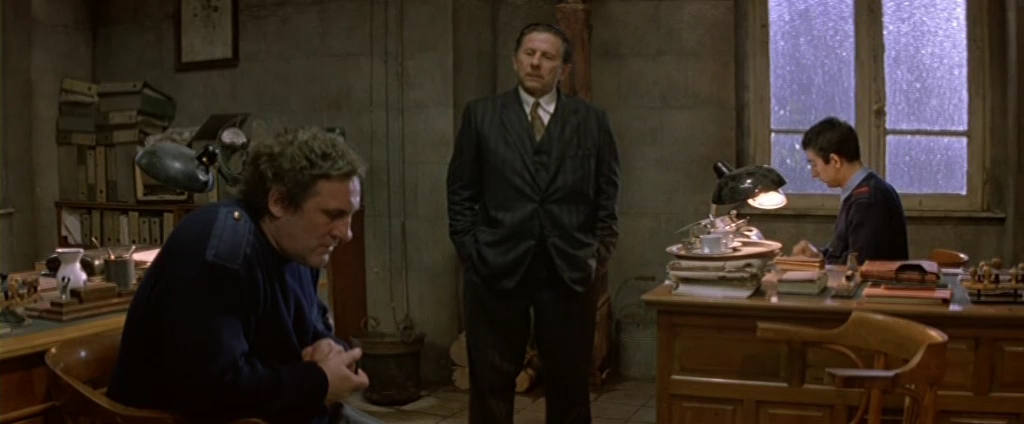
As a precursor to a journey that will be undertaken for almost the entire 108-minute duration of the film, A Pure Formality opens with a point-of-view sequence of someone trying to find a way through a dense forest on a dark, rainy night, after we, the viewer, have stared down the barrel of a gun moments before a bullet has been fired. The man (Depardieu), soaked to the skin, shoes caked with mud, and quite disoriented, is apprehended by a couple of policemen, who bring him to a ramshackle police station after he fails to produce any sort of identification. His earnest requests that he has an important meeting next day for which he will get late fall on deaf ears, when the captain of the station insists that he wait for the Inspector to arrive and ask him a few questions.

Once the Inspector (Polanski) makes his entry, the film becomes an engrossing tête-à-tête, during whose numerous twists and turns a mystery will be solved. But a few intriguing questions get answered almost as soon as the ‘interrogation’ begins. We learn that Depardieu’s character is, in fact, a renowned novelist named Onoff. Unfortunately, for Onoff, the realisation that the time when ‘people knew who I was before I even said “Hello”’ seems to have gone forever dawns when he finds that even though the Inspector is an ardent admirer of his work—to the extent that he can recite chunks of what Onoff wrote verbatim—he fails to recognize him at first. Maybe, it has something to do with the fact that Onoff’s characteristic thick beard is missing. Or is it because it has been six years, during which he has become a recluse, since he came out with his last published work?

But there are other more important questions that remain, and to the Inspector, it seems that Onoff can help in answering them. For example, the identification of a body, whose face has been badly mutilated, that has been discovered not far from Onoff’s farmhouse. Then, of course, there is that little niggling query about what Onoff was doing running around in such torrential rain, without an umbrella or a raincoat.

Onoff himself is quite apathetic to being interviewed. In his own words: ‘Interviews are pointless…Someone visits you to make you say what he already knows, for the pleasure of hearing you repeat it.’ Little does he or the viewer know that like a true writer he has phrased a truism, and that, too, unknowingly. As the conversation continues between the Inspector and Onoff, questions are faced with adamant opposition, contradictory information, and eventually an intense introspection. The outcome is as much a revelation for Onoff, as it is for us.

There are other films based on the premise of an interrogation. Examples include the Morgan Freeman and Gene Hackman starrer Under Suspicion (2000) and the Australian film The Interview (1998) which has Hugo Weaving in it. The pure pleasure of watching A Pure Formality does not lie in the fact that the film deals with the unraveling of an intricately crafted puzzle. But its enjoyment lies in the manner in which clues to the solution of the conundrum are laid out as the film progresses, similar to the bowls scattered across the floor of the decrepit police station to collect dripping water from the leaking roof. 

For almost the entire runtime of the film, there are only three characters on screen—Onoff, the Inspector, and Andre (Sergio Rubini), a young policeman, who has been entrusted with the job of transcribing the interview. The fourth character that ensconces these three is the rundown police station. There is a clock, but it has no hands, indicating time has all but stopped here. There is a phone, but we are told that the phone lines are the first casualty whenever there is a storm, implying estrangement from the rest of the world. And there is a cupboard, whose contents include important official documents, a few bottles of wine, a couple of glasses, and a mousetrap.

Each of these components of mise-en-scène comes into play as the film moves forward, but special mention needs to be made of the mousetrap, which is also an homage. It refers to the titular murder mystery written by Agatha Christie. Like the play, in A Pure Formality, a body has been found. While in the drama, four guests are forced to lodge in a guest house due to heavy snowfall; Onoff finds himself inside a dilapidated police station while it is raining cats and dogs. The guests in The Mousetrap are informed of a death by a detective sergeant; while it is from the Inspector that Onoff learns that a body has been found near his farmhouse. Most importantly, there is a twist ending in the play, as well as in A Pure Formality.

While Tornatore was gracious enough to strategically place an object of ode in his film, there are at least two directors, who have blatantly ripped off the crux of the story as well as some important plot points from him. Surprisingly, while both films are well known, one of these two went on to garner massive collections at the worldwide box office, while A Pure Formality till this day lingers in the shadows.

Just goes to show that life can be pure fatuity, at times.