Sunday, March 27, 2011

The Circle of Coldness and Cruelty


The seventeenth-century English philosopher Thomas Hobbes had once said, ‘All generous minds have a horror of what are commonly called "Facts". They are the brute beasts of the intellectual domain’. In Tras el Cristal (1987) a.k.a In a Glass Cage, Spanish director Agustí Villaronga’s ‘art shocker’, Klaus (Günter Meisner) has an 0ld habit of keeping record of certain facts about himself that are so disturbing that he has managed to keep them a secret from his wife Griselda (Marisa Paredes) and his little daughter Rena (Gisèle Echevarría). Little does he know that soon these facts will come back to haunt him, in an excruciatingly horrifying manner, embodied in a beast, ironically named Angelo (David Sust).

Similar to Psycho (1960), Tras el Cristal tells the crux of the story that will eventually unfold in the pre-credit sequence itself. The film opens with close-up shots of an eye and a camera, followed by click of the shutter perfectly synched with the blink of the eye. At that very moment, we the viewer, become privy to the fact that the film is all about ‘looking’, ‘listening’, and ‘memories’.

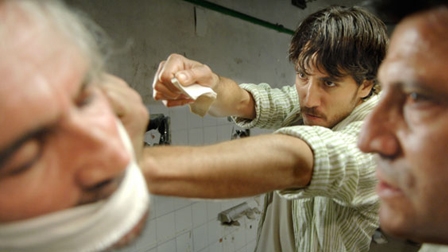
As the scene unfolds, we see a man (whose name we shall learn later, is Klaus) clicking photographs of a young boy, who is naked and wounded, hanging from the ceiling with his hands tied up. It is around this time that another gaze enters the frame—a point-of-view of a third entity, hidden outside the building and peering through the window, looking at both Klaus and the obviously numb-in-pain youth.

If one goes back to Hitchcock’s most famous film, one will remember how there, too, in the opening sequence, an external gaze, in a swooping bird-like motion, enters a motel room where two individuals are involved in another type of activity, which, like Klaus, they, too, want to hide from the eyes of others. But in both instances, Hitchcock and Villaronga turn the audience into voyeurs by using point-of-view shots, and thereby make them accessory to the ensuing horrific events.

There is similarity between the two opening sequences in a sense of foreboding as well. While the bird-like swooping movement in Psycho alludes to Norman’s hobby of taxidermy as well as his predatory instinct, in Tras el Cristal, the ‘gaze’ pertains to knowledge. Unlike Klaus, we know that he is being watched, and unknown to Klaus, we see someone picking up a diary from the scene of the crime. And knowledge, as we shall see, will play a pivotal role in the remainder of this treatise on sadism, violence, and voyeurism.

A distraught and repentant Klaus, wishing to put an end to the evil inside him, tries to commit suicide. However, he fails, and instead of finding himself inside a coffin, lands up inside an ‘iron lung’—an artificial, metallic respiratory contraption, in which his paralysed body lies immobile, with only his head sticking out under a glass dome. While Klaus remains cocooned inside the breathing apparatus, Griselda and Rena, we learn, have remained imprisoned within the four walls of their mansion, ever since the family went into exile eight years ago. Into their lives walks in Angelo, a young man, who proclaims to having taken care of Klaus when he was in the hospital.

In sync with the first sequence of the film, where we could only hear his breathing and never come face-to-face, we ‘hear’ Angelo, long before we ‘see’ him. We find him threatening to reveal what Klaus did before he jumped off a roof, if he is not hired as his private nurse.

And when we do get the first glimpse of Angelo, we see him through the gap of a door not fully opened, telling us that there is a lot more to this young man than our eyes can discern at first glance.

For Klaus, the horror begins almost immediately. At night, when the two other members of the family are fast asleep, Angelo tiptoes into Klaus’ room and starts reading out from Klaus’ own diary, the despicable acts he had carried out on little boys when he was employed as a Nazi doctor. As if reliving those disgraceful days and heinous deeds were not enough, very soon Angelo reveals to Klaus” ‘I could be what you used to be’.

With paedophilia as an underlying theme, Tras el Cristal is not an easy film to watch to begin with. But by making innumerable references—both oblique and direct—to scopophilia (the act of deriving pleasure from looking), it makes the experience a first-hand one for the audience. Like Klaus, who is stuck in a contraption for the rest of his life, and has no other option but to look at his ‘mirror image’ in Angelo via an actual mirror that Angelo erects in front of his face; or similar to the young boys who Klaus used to strap down to a chair before abusing them, we the viewer find ourselves rooted to our seats, equally powerless and horrified by what is happening before us, but unable to look away.

In fact, to underline this very aspect, Villaronga, through the character of the maid of Klaus and Griselda’s household, tells us, though in a different context: ‘The machine makes me nervous. It’s like being in the cinema’. To add to the overall claustrophobic experience, Villaronga supplements his visuals, which are perpetually bathed in swathes of icy blue and depressing gray, with ingenious sound effects. The suggestive ‘beast within’ comes alive as much as in the screeching mechanical heaving of the ‘iron lung’, as it does via the sound effects depicting the rattler of a rattlesnake and the squeal of a wounded animal, during two pivotal scenes in the film, wherein the life of one individual lies at the mercy of another.

To the frequent film-watcher, the parallels to Bryan Singer’s Apt Pupil, a film that was released more than a decade after Tras el Cristal, are obvious. However, unlike its distant, watered-down cousin from Hollywood, this Spanish film has built up a certain reputation for itself—and quite rightly so. Rather than merely slapping an in-your-face message of ‘immorality never pays’, it actually manages to be disturbing because it turns the audience into an accomplice.

Just like Angelo used meshed wire to turn the hallway of Klaus’ house into a replica of those numerous concentration camps, Tras el Cristal creates the eponymous glass cage for the audience, as well. We are infantilised, immobile, and passive in our response, but very much active in our participation. Klaus is made to look through the crystal dome via a mirror. We just cannot tear our gaze away from the screen. 


Sunday, March 20, 2011

Reinventing the ‘Re’ in Revenge


In the fourth season of the TV series Lost, the antagonist Benjamin Linus tells the former Iraqi National Guard Sayid Jarrah: ‘When you let your grief turn into anger, it will never leave you’. In South Korean director Jee-woon Kim’s latest offering Akmareul boatda (I Saw the Devil), Kim Soo-hyeon (played by Byung-hun Lee; who some of us might remember as Storm Shadow in the awful GI Joe: Rise of Cobra), who works for the National Intelligence Service, has every reason to be aggrieved. His fiancée, Joo-yeon, with whom he got engaged just a month ago, has been found hacked to pieces by an unknown assailant, while she was waiting by the roadside for a tow truck.

Soo-hyeon, like his innumerable precedents on celluloid who had been wronged, promises to avenge Joo-yeon’s murder by ‘inflicting 10,000 times more pain’ on the assailant—a claim or its variant that, too, has been made time and again on the silver screen. Till then, ‘I Saw the Devil’ follows a tried-and-tested formula that lies at the core of any revenge flick. And if it had been just another entry in this sub-genre of films, it would have ended at around the 55-minute mark. Because that is when, Soo-hyeon lays his hands upon the dastardly serial killer Kyung-Chul (another bravura performance by one of the most well-known actors ever to emerge from South Korea, Min-sik Choi), after staking out three more suspects.

The evidence that Kyung-Chul is, in fact, Joo-yeon’s—and several other equally unfortunate women’s—murderer is irrefutable; the dastardliness of Kyung-Chul, irredeemable; the fury of Soo-hyeon, as he lifts a large boulder to snuff out Kyung-Chul’s life, inconsolable. So, when the passed out Kyung-Chul regains consciousness to find that all he has lost is a pint-odd of blood and the functionality of his left wrist, and has, in fact, gained a wad of currency notes left behind in an envelope, he is as surprised as us, the viewer.

That is also the precise point, when Akmareul boatda (2010) begins to deviate from other run-of-the-mill revenge flicks.

Mildly flabbergasted but largely condescending of what he deems to be his unknown attacker’s foolhardiness, it does not take the psychopathic Kyung-Chul long to pick up, from where he had left off, when it comes to hunting down women. But to his utter astonishment, whenever he finds himself a new prey, Soo-hyeon arrives out of the blue, again and again, almost on cue, and inflicts pain on Kyung-Chul that keeps getting worse.

But Kyung-Chul is no ordinary psychopath. His proclamations that others are nothing but ‘retards’ are not boastful claims, but a statement of fact. It is only a matter of time before he figures out exactly how Soo-hyeon is managing to appear at precisely the same place where Kyung-Chul is planning to devour another hapless human.

And when he does figure out, Soo-hyeon finds that in this particular psychopath, the answer to ‘Who do you think won? You or me?’ is not as simple and straightforward as it sounds.

‘Violent thriller’ is a sub-genre that has found itself resuscitated by new Korean cinema. Chan-wook Park, Jee-woon Kim, and Hong-jin Na are just three of the new breed of film directors, who have firmly put Korea onto the map of world cinema, resulting in that classic knee-jerk reaction from Hollywood—churning out remakes.

Among these three, Park maybe the most famous—after all, his Oldboy (2003) re-introduced modern Korean cinema to the world—but it is Kim, who has the most diverse filmography. His previous three films were an action-adventure (The Good, the Bad, the Weird), a crime drama (A Bittersweet Life) and a top-notch horror (A Tale of Two Sisters; remade in Hollywood in 2009 as The Uninvited). And with Akmareul boatda, Kim has broken new ground. Not only has he carried on the creative acumen that he has ostentatiously displayed in his earlier works, but has also managed to push the envelope, so much so that Akmareul boatda, because of its violent content, became the first instance in entire Korean film history to be restricted twice by the authorities. Considering the amount of violence that has perpetuated the current crop of Korean films—that tells a lot.

However, there is a lot that separates Akmareul boatda from the violent trash, tripe, and travesty that Hollywood keeps churning out on a regular basis. To begin with, Kim has made it abundantly clear that there is not much of a difference between the avenging Soo-hyeon and the atrocious Kyung-Chul. From the latter using a hammer to mercilessly dispose of Joo-hyeon, to Soo-hyeon using the same weapon on a sex-offender; from Kyung-Chul using a vehicle to pick up his unfortunate victims, to Soo-hyeon using his car to incapacitate one of his targets; from the remorseless manner in which Kyung-Chul chops off one of his preys, to the inability of Soo-hyeon to break down when he learns about his fiancée’s fate; from the instantaneous movement of Kyung-Chul’s chopper on a woman’s body, to the split-second stomping of Kyung-Chul’s wrist by Soo-hyeon; from Kyung-Chul using a dumbbell to bludgeon a guy, to Soo-hyeon bashing Kyung-Chul  with a fire extinguisher; Soo-hyeon—initially unknowingly, and then consciously—emulating a coda followed by the serial killer regarding the manner in which body parts are cut off; and last, but not least, the sweeping panning of the camera that directly connects a distraught Soo-hyeon to Kyung-Chul prowling the streets in search of his next victim—the instances are many.

While the gore is almost unbearable, the violence unapologetic, and the fierceness of both the protagonist and the antagonist unflinching, the film has its own share of dark humour, evident in the two instances when the battered Kyung-Chul tries to hitch a ride or when a psychopath calls his victims ‘crazy’.

Refreshingly, the supporting characters in Akmareul boatda do not condone Soo-hyeon’s actions. On several occasions, we hear them imploring that the path he is following will not bring back the dead, nor is it necessary to become a monster to fight one—a feature inconspicuous by its absence in the plethora of revenge films that we encounter every year.

The other interesting aspect of the film is how it has subverted a number of cinematic tropes. How often do we find a psychopath in a situation where he has to fight for his life fending off two more of his kin; the handle of a screwdriver coming off when someone tries to dislodge it from his palm; or the audience finding their sympathy being inadvertently swaying towards an immoral individual?

It is this ingenuity that is present even in the title of the film itself. The Korean phrase Akmareul boatda simply means ‘Saw the Devil’, without any subject, which can imply the devil being either Kyung-Chul or the evil that lay hidden inside Soo-hyeon, only to emerge as the film progressed.

All in all, while breathing new life into this catatonic sub-genre, the Koreans have shown that unlike the Chinese, who like to eat the dish of revenge cold, they prefer to have a second helping, and a third, and a fourth….  


Sunday, March 13, 2011

The Charm and Challenges of Childhood


 As the Turkish director Atalay Taşdiken’s award-winning film Mommo (2009) opens, we see the elderly Kazim (Mustafa Uzunyilmaz) putting household items on a mule-drawn cart. As soon as his second wife boards the vehicle, he drives away, not even sparing a cursory glance at his cherubic little daughter Aysa (Elif Bülbül) or at his nine-year old son, Ahmet (Mehmet Bülbül), who emerges from the background. There is a yawning gap between the two kids—symbolic of the vacant space their father is leaving behind in their lives.

The two kids now stay at their grandfather’s (Mete Dönmezer) place. Grandpa is old and infirm. Fate has snatched away the working of two of his limbs, but has failed to do the same to the pride of this stoic, old man. Deep down, Grandpa knows that he is living on borrowed time, and the little savings he has accrued from his pension, which barely allow him to make both ends meet, are fast running out with the addition of these two members to his household.

A disgruntled Ahmet, angry at his father, finds himself filling up multiple shoes for little Aysa. He becomes her brother, confidante, and surrogate parent. During the beginning credit sequence, we see Ahmet carving a small boat out of a plank of wood. In reality, he finds himself inadvertently landing with the burden of carving a life for both himself and his sibling.

Life is tough for the brother-sister duo in this tiny Turkish village. The kids in the playground, led by Abidin, their stepmother’s son, taunt Ahmed telling him to go ‘play house’ with his sister than participate in a soccer match. Aysa is branded an ‘infidel’—a term, whose meaning is unknown to the wide-eyed and confused child—by the daughters of the affluent families, when she takes part in a game of hopscotch. Then there are rumours floating around that the partly-paralysed Grandpa might get married again and that Ahmet and Aysa will be sent to a children’s home.

Amidst all these adversities, Ahmet tries his best to keep Aysa happy. He builds a swing for her with a rope and a pillow for a seat; offers her his worn-out T-shirt when she gets wet while playing in a brook; tells her stories; combs her hair; and stands guard when she cleans her hair in the public bath.

There is a particularly poignant scene where the two siblings play with the wooden boat that Ahmet had crafted in the water of a makeshift dam made of stone. That dam is symbolic of the world the duo have created around them—away from the painful reality of their circumstances, a small, joyful corner of their own. But their fun is short-lived, when a villager, irate with the makeshift dam, shovels the rocks out. A helpless Ahmet and Aysa can only stare at the wooden toy sailing past them, never to come back.

At night, they sleep on the roof of Grandpa’s house, under the stars, to avoid keeping the old man awake while Ahmet answers all of Aysa’s innumerable questions in a practical, matter-of-fact manner. And more than often, he has to allay Aysa’s fear of the bogeyman, who she believes hides in the storeroom and can be seen through the hole that serves as the window.

Ahmet finds himself and his sister akin to the hollyhocks—the ‘orphan flowers’, as his mother used to call them. His only friend in the entire village is the local grocer ‘Istanbullu’ Bakkal (Mehmet Usta), who frequently gives away chocolate wafers and chewing gum to the two kids. While Ahmet puts on a brave face as he goes about his daily chores of cooking, running errands for his grandpa, and giving his sister company, the fact is he is just a nine-year old boy. So, he too, breaks down, but does so discreetly, away from the gaze of Aysa or grandpa.

Meanwhile, a ray of hope arrives for the brother and sister in the form of a letter from their aunt Fatma, who stays in Germany. She writes that she and her husband are trying hard to bring Ahmet and Aysa to join their family, but the laws of the land and the necessary paperwork are hampering them. Grandpa is trying in his own way to keep the kids happy. But, pragmatic that he is, he knows that on his old-age pension the once-in-a-month feast of kofte will soon turn out to be a luxury he will not be able to afford anymore. Pride does not allow him to keep the doors open when he makes bread, lest the neighbours get to learn that he does not have money to make a purchase from the bakery; nor does it allow him to agree to Gulseren, a lady from the village, who comes with the proposal to send Aysa to work as a servant for a rich family.

But how does a frail old man, fight with the forces of fate that are slowly, but gradually, putting him into a corner?

Born in the Konya province of Anatolia himself, Taşdiken, who also wrote the screenplay for Mommo, offers not only an insider’s view into Anatolian village life, but also draws an equally astute picture of what it is like for children to grow up in such surroundings. While there lie an innate happiness in riding a bicycle along a dusty road with one’s sister riding pillion, sleeping underneath a blanket of stars, writing a letter on behalf of one’s grandfather; there are also the tears that follow after being tonsured, the confusion that arises when one thinks the boy at the soccer field knows a secret that can jeopardise one’s and one’s sibling’s lives, and the fear when a child of nine looks into a hole in the wall staring at him, even though he has made himself believe that the bogeyman is a figment of his father’s imagination.

It will take a cynical mind not to be swayed by the sheer simplicity of the story that is Mommo; a stone heart not to want to reach out through the screen and give the angelic Aysa a tight hug; and a superhuman self-restraint not to allow a sigh escape and a lump rise in our throat when the film comes full-circle at its heart-wrenching conclusion.

Sunday, March 6, 2011

Magic, Materialism, and Melancholy


Paris. 1959. The vaudeville theatres of France find themselves in the middle of a losing battle against the proliferation of television, showy rock stars, and other new forms of entertainment. In such a fast-changing scenario, an elderly illusionist, Jacques Tatischeff, finds himself and his quaint art form as difficult to fit in, as he finds it hard to manage his mischievous little pet rabbit while pulling it out of the hat in front of an ever-diminishing audience. 

Undeterred, he decides to shift base and comes to London, where he takes up assignments at garden parties to make ends meet. But here, too, the only appreciation he gets while conjuring wine glasses out of thin air is from a Scottish guest, who is as full of liquor as the glasses in Tatischeff’s hand. On this inebriated individual’s invitation, Tatischeff arrives at a remote Gaelic-speaking island that has only recently been electrified. No wonder then, the villagers find switching a light bulb on and off and crowding around the jukebox as enthralling as any magic trick.

In the same inn where Tatischeff is lodged works Alice, a young girl entrusted with doing laundry and keeping the premises clean. To her impressionable mind, the illusionist’s performances in the pub are not sleight of hand, but true magic and Tatischeff, a mystical magician in the flesh. And when the elderly illusionist buys her a pair of new red shoes, to replace her old, tattered ones, Alice, like Dorothy of The Wizard of Oz decides to go on what she believes will be an equally magical journey. Only this time, rather than taking the yellow brick road, she follows Tatischeff and convinces him to pay Edinburgh, a land famous for its street performers and magicians, a visit.

Once in Edinburgh, the two of them put up at Little Joe’s Hotel—a rundown establishment, whose residents include a triplet of trapeze artists (an oblique reference to the same director’s equally adorable 2003 film The Triplets of Belleville), a down-on-his-luck anorexic mime, and an out-of-job ventriloquist—all of whom represent the microcosm of the slowly-dying traditional forms of entertainment.

As the young Alice slowly gives in to the lures of a big-city life, Tatischeff, egged on by the opportunity to redeem a missing piece in his own life, and unwilling to let go of the only audience he has who still seems to believe in magic, decides not to break the spell. He starts showering her with increasingly expensive gifts, while hiding from her his own struggles that force him to take up obscure jobs like working in a garage, painting billboards, and even working as a live demonstrator at a shop selling women’s perfume and undergarments. While Tatischeff regales the passersby from the store’s window, one day Alice finds love across the street, while peeking out of the window of her hotel room. The last vestige of magic seems to come to an abrupt halt in Tatischeff’s life, as he confronts the reality that life so stone-heartedly shoves in our faces.

Based on an unproduced script by the acclaimed French director and actor Jacques Tati (whose full-name was, in fact, Jacques Tatischeff) L’illusioniste (2010) is a double ode. Tati’s script, which he wrote in 1956, but never got around to depict on celluloid, was a thinly-veiled dedication to his daughter, who he had abandoned early in her life. In his L’illusioniste, director Sylvain Chomet has, in turn, paid his homage to the French master. In this sublime hand-drawn full-length animation film, which, incidentally was nominated at the recently-concluded 83rd Annual Academy Awards in the Best Animated Feature Film of the Year category, Chomet, while staying true in depicting Tatischeff in the physical likeness of Tati, has also carried forward Tati’s signature approach to film making that is known for being sparse in dialogue but rife in emotion.

Think of the dialogue-less but heart-wrenching initial sequence of Pixar’s Up (2009) extended to an eighty-minute run time that is buoyed by beatifically drawn characters who speak volumes through body language and a lilting musical score composed by Chomet himself, and one can have a preliminary idea of L’illusioniste. At the same time, it offers a sharp criticism of the consumerist society we live in and our preponderance to discard the old without so much as batting an eyelid. A tale of relationship that has shades of Chaplin’s brilliant Limelight (1952), it shows how all of us are in constant pursuit of one illusion or the other, while ironically, those who pursue conjuring illusions as a trade lie long-forgotten.

When all of us hanker after a little magic in our lives, it is indeed tragic that circumstances can compel a professional illusionist to forsake his art in the face of cold reality. That the curtain has fallen, in particular, on the kind of magic that Tatischeff and his compatriots once plied, and in general, on vaudeville music halls is immaculately depicted by Chomet in the penultimate sequence of L’illusioniste. One by one all the lights outside of a ‘variety theatre’ are turned off, with ‘Music Hall’ being the last two words to fade.

However, true to his master Tati, whose characters always exhibited an immense joie-de-vivre in times of external adversity, one little firefly fleets across the screen, while the lights breathe their last. That tiny insect is a harbinger of hope—hope for hand-drawn animators, who find themselves relegated to the background when computer-generated animation is the preferred option; optimism that human emotions will succeed in eking out a place in a world succumbing to materialism; and faith, that no matter how much we progress, there will always be space for magic in our lives.

Saturday, February 26, 2011

The Mutating Cell


 The eponymous Celda 211 (Cell 211) of the Prison Central Provincial in the Spanish city of Zamora has a certain reputation among the prison’s inmates. Its last occupant, Morao, who had a tumour in his brain ‘the size of a kiwi’, spent his last days in there in the throes of unimaginable pain, all the while screaming for help. But his cries were never answered by the prison guards. However, the walls were eager listeners, on which Morao, ignored, impaired, and in suffering, had inscribed barely intelligible words that bear testament to his agonising last few days. Possibly because of the way in which he died, the cell is now kept empty, but a sense of foreboding prevails within. Maybe, the vacancy is also explained by the fact that El Morao in Spanish means ‘he dwells’?

Though the above description is more befitting of a horror film, but Daniel Monzón’s eight Goya (the Spanish equivalent to the Oscars) winning Celda 211 (2009) is in reality an exceptional prison drama that unfolds against this setting. 

When the unconscious 33-year-old Juan Oliver (Alberto Ammann) finds himself being slapped back to reality in that very cell, he is quite oblivious of its morbid past. In fact, he is not supposed to be inside a prison cell in the first place. All he knows is that he has been employed as a guard at the Prison Central Provincial—a job he was supposed to join the day after. Leaving his wife, Elena (Marta Etura), who is six-months pregnant, at home, he had decided to pay his new employers a visit a day before his first working day, just to see ‘how things work’. He was being shown around by his two colleagues Armando and Germán, when an explosion occurred and he lost consciousness.

It does not take the groggy Juan too long to understand that he is in the middle of a nightmarish scenario—a riot, led by the raspy-voiced, bald-headed, life-sentence-serving Felipe Gonzalez, popularly referred to as Malamadre (slang for ‘bad mother’), has broken out. Before long, he is dragged in front of Malamadre (played impeccably by Luis Tosar). Juan realises, to his utter horror, that to survive, he has no other option but to win over the trust and confidence of Malamadre and his cronies by making them believe that he is one of them—a fellow inmate.

In a world where a handmade musket, built out of pipes and spring, is worse than its actual counterpart; where a spoon doubles up as a lethal weapon; and justice is often meted out with iron rods, Juan knows one false step, one wrong answer, one betraying expression could well be his very last. While thinking on his feet, he figures out that his only hope of seeing the outside of the prison walls is to keep his act together, and helping out the prison officials deal with the situation, at the same time.

As the prison warden Jose Roca and his colleagues wait for the SWAT team to arrive, the situation gets aggravated when Malamadre reveals his trump card in the negotiations that he will undertake with the officials. He takes three terrorists—members of the ETA, a Basque separatist organisation, who are holed up in the same prison but in an isolated ward—as hostage, threatening to kill them if his demands are not met. As the goings-on get more and more politicised, a federal envoy is sent in to negotiate, the SWAT team is kept on high alert, the local radio station breaks the news, TV coverage begins, and civilians start thronging the prison gates. Among the crowd is Elena.

Meanwhile, tension mounts within the prison walls. It becomes quite apparent to Juan that ensuring that the three ETA members are not endangered is more of a priority to the envoy than saving his life. With news of similar riots breaking out in other prisons filtering in, the negotiator reveals that giving in to Malamadre’s demands might not be possible for the simple fear of inciting the riots elsewhere. And Apache (portrayed by Carlos Bardem, older brother of Javier), a fellow Colombian inmate and the prison officials’ snitch, is growing more and more suspicious of who Juan really is.

Of all film genres, prison drama is, arguably, one of the most cliché-ridden. However, writer-director Daniel Monzón (who also wrote and directed the Hitchcockian suspense thriller The Kovak Box) has succeeded in steering clear of almost all the usual triteness in this riveting film. Instead of dishing out another story involving sadistic wardens, vicious guards, and impossibly ingenious escape plans, Monzón has opted to depict a subtle indictment of the prevailing Spanish incarceration policy—in particular, the Designated for Special Surveillance (DSS) part of it that is meant for ‘murderers, jail-breakers, and psychopaths’.

In Celda 211, Monzón has shown that the Spanish prison system, like most of its brethren the world over, is hampered by hierarchy, mired in bureaucracy, and burdened with political pressure. In a vital scene in the film, he voices how he believes convicts in Spanish prisons are treated, when Juan exclaims: ‘We’re trash, and what you do with trash is take it out before it stinks’.

While touching upon the core ideas of any film that deals with prison life, such as the process of dehumanisation of the convicts, defiance of inmates against inhumane treatment, and prisoners’ constant battle with authority, Celda 211 goes one step farther. It shows that the four walls of a prison cell is a law unto its own. Sometimes, an innocent man enters the space, albeit unwillingly, and gets transformed into a transgressor. 


Sunday, February 13, 2011

Just who are the monsters here?


‘We have learned now that we cannot regard this planet as being fenced in and a secure abiding place for Man; we can never anticipate the unseen good or evil that may come upon us suddenly out of space’. — H G Wells

This sentence, from Wells’ The War of the Worlds, published in 1898, has, since the 1950s, served as the template for a sub-genre of science fiction films—the alien-invasion movie. Notable examples include: The Day the Earth Stood Still (1951), It Came From Outer Space (1953), Invasion of the Body Snatchers (1956, remade in 1978, and re-remade as the inferior The Invasion in 2007), Earth versus Flying Saucers (1956), Independence Day and Mars Attacks (both in 1996), Men in Black (1997), Men in Black II (2002), and the superb District 9 (2009);  not to mention the attempts made at bringing that particular classic of Wells to the silver screen—the first in 1953 by Byron Haskin, and the next, an adaptation that came out 52 years later, helmed by a certain Steven Spielberg. The recently released Skyline (2010), and the upcoming Cowboys and Aliens (2011) starring the dynamic Ford-Craig duo and Battle: Los Angeles (2011)  make it apparent that screenwriters and directors are not yet ready to forsake this once-fertile sub-genre.

What is also common to almost all these aforementioned films is that in each case, the aliens seem to have a particular agenda—a hostile takeover of planet Earth. It seems we have all but forgotten that Wells had, in his writing also mentioned the words ‘unseen good’. It is true that Gareth Edwards’ Monsters (2010) does not delve into that particular aspect of an alien invasion; at the same time, it would not be incorrect to state that he has portrayed a scenario that makes the sub-genre almost come full-circle—back to The Man from Planet X (1951), where the visitor from outer space was not a belligerent foe but a benign extraterrestrial.

Six years prior to the incidents depicted in Monsters, we are told that NASA discovered alien life on Europa, one of Jupiter’s 63 moons. A deep-space probe was sent to Europa, which, however, crashed over Mexico during re-entry. Since then, new life forms have begun to appear in and around the area, so much so that half the country had to be quarantined as an ‘infected zone’. While the US and Mexican military are on continuous vigil against the ‘creatures’, a huge man-made wall has been erected at the US-Mexico border, while tall fences try to keep the tentacled aliens out of civilian-inhabited areas.

Our male protagonist, Andrew Kaulder (Scoot McNairy), is a photographer working for a magazine. Posted at San Jose, Central America, his intentions of following the story of his life suddenly faces a roadblock, when he is asked by his superior to take on a completely unrelated assignment—to escort the magazine’s owner’s daughter, Samantha (played by McNairy’s real-life spouse Whitney Able) to the US border. Thus begins a journey that will take the two of them through the dreaded ‘infected zone’.

The landscape is littered with evidences of large-scale destruction. Buildings have been turned into rubble, helicopters have crash landed by the road, an aircraft and a tank are seen sunk in water, and there are cars on trees. Curiously, amidst this bleak scenario, Sam and Andrew—as alien to each other as the creatures they fear might attack them anytime—start to drop their individual guard slowly but gradually, and begin to learn more about one another.

At the same time, they start gaining knowledge on the towering, tentacled tormentors. They are told by the group of armed men who are accompanying them to the US border that the creatures are amphibians—they stay mostly in water, crawl up to the land at times, and lay eggs in trees. They are also told that ‘If you don’t bother them, they don’t bother you’. Similar to the visitor from The Man from Planet X, who only turned violent after being confronted by an evil scientist, the creatures in Monsters are known to attack only when they are fired upon.

With a budget as low as $800,000 (some mention it to be even lower, at $500,000); a meagre three-week long shooting schedule; location shooting for the entirety of the film in Mexico, Guatemala, Costa Rica, and Texas; and while helming the quadruple responsibility of director, writer, production designer and special effects, the Brit Gareth Edwards has taken a route diametrically opposite to his American counterparts like Michael Bay. Just as Andrew and Sam, while standing at the US-Mexico border stare at the gargantuan wall and realise that there are not many occasions when Americans get an opportunity to look at their country ‘from the outside in’, Gareth, too, wonders at our penchant to shut out what we do not understand because we immediately reckon it to be threatening.

For those of us searching for it, there is an obvious political subtext to the film—that of immigration, but there are two other aspects that make this road movie nestled inside a sci-fi fascinating. One is that the aliens, unlike the overwhelming majority of their ilk that has been depicted on celluloid, are completely without an agenda. In fact, they are trying as hard as us to survive on this unfamiliar planet. And second is how the fact that the overarching theme that humans and the creatures are two life forms that seem to be unable to understand each other is reflected in the story of Andrew and Sam. They started off as strangers, and when they understood each other, they understood the ‘monsters’, too.

It is indeed an irony that we are sending signals to outer space in search of intelligent life forms, but have this penchant for shutting out anyone or anything that does not seem to conform to our preset notions, views, and perspectives. It is communication that broke the mental fence that Sam and Andrew had erected between themselves. But the US military did not follow suit, while dealing with the creatures. They opted to open fire instead, thereby vindicating the words of another doyen of science-fiction, Isaac Asimov, who had asserted in Foundation, ‘Violence is the last refuge of the incompetent.’

Sunday, February 6, 2011

A Truly Sweet Revenge


With the 83rd Oscars—the Academy of Motion Pictures and Sciences’ annual tentpole event—barely weeks from now, it will now be a decade since the edition remembered the most by majority of Indians. That was when Ashutosh Gowariker’s Lagaan failed to bowl out the rest of the competition in the ‘Best Foreign Film’ category. Equally disheartened across the globe that year, and since then, has been an ever-increasing number of cine-lovers, who just cannot fathom how Jean-Pierre Jeunet’s utterly charming Le fabuleux destin d’Amélie Poulain (aka Amelie) did not win enough hearts at the Academy to win the trophy in the same category.

A self-taught filmmaker, Jeunet belongs to a dying breed of directors—the ‘auteur’ (or author). A much-influential film theory that evolved in the 1950s in the seminal French film journal Cahiers du Cinéma, the auteur theory argues that just like authors use the pen to express themselves in literature; each film, too, should reflect its director’s own vision. One can view this as the filmic equivalent of expressionism in painting—with both putting emphasis on the creator’s (painter/filmmaker) subjective perspective.

The hallmark of an auteur is that it takes the viewer only a couple of moments to guess the director correctly, every time he/she views any instance from his/her body of work. In other words, an auteur leaves his/her signature behind in his/her films.

Jeunet’s signature is the way he digitally manipulates colour in every frame. Like a true auteur, he has stuck to his trademark visual aesthetic in his latest offering—Micmacs à tire-larigot (2009), which roughly translated into English, means ‘Non-stop shenanigans’.

Bazil (Dany Boon) is a thirty-something video store clerk, who can recite dialogue from films from memory. As a kid, he lost his father—a soldier—in Morocco to a landmine. While that particular weapon of war broke his heart, another product of arms manufacturers—the revolver—leaves behind a much more apparent scar. A stray bullet from a shootout that occurs right in front of his video store hits him right in the head and lands in his brain. Gauging that operating on Bazil might have fatal consequences; a surgeon decides to leave the bullet where it is.


Stripped off his job and ousted from his home, Bazil spends two months roaming the streets begging, till he meets Slammer, an ex-convict. Slammer, aware of the fact that the bullet could pop Bazil’s brain any second, tells him that he knows of a family who will still be willing to adopt him. Slammer introduces Bazil to a motley crew of individuals, who live in a junk yard. There’s Mama Chow—the cook, who is also in charge of recruiting; Calculator, a young girl capable of conducting complex mental calculations in an instant; Tiny Pete, who can create wondrous automatons using scrap metal; Remington, a former ethnographer from Congo, who speaks in old-world clichés; Elastic Girl, a contortionist; and Buster (played by Jeunet’s perennial favourite Dominique Pinon), a human cannonball. They spend their time salvaging defective stuff. No wonder then, they welcome Bazil.

One fine day, while collecting junk, Bazil realises, to his utter amazement, that the company that manufactured the landmine that blew his father into smithereens and the organisation that was behind the bullet that is now a ticking bomb in his brain, have their headquarters on opposite sides of the same street. Like Amelie, who decided to take matters in her own hands to teach the local vegetable vendor—who repeatedly ill-treated his dim-witted employee—a lesson; Bazil, does not get mad at the CEOs of the two companies. He, too, decides to get even, while being ably assisted by his family of six.

With the sombre topic of international arms dealing as the backdrop, and the morbid situation of the protagonist, who has lead in his head, Micmacs could easily have turned into a dark, brooding thriller. But similar to Jeunet’s characters, who never get bogged down by their circumstances, and his frames, which show the world in a different hue than usual, the film does a volte-face and takes on an amusing avatar. Akin to The Big Sleep (1946)—a film the adult Bazil was watching when we first see him on screen—which deals more with the process of a criminal investigation and ponders less on the results; Micmacs, too, is more about how the magnificent seven go about extracting revenge, than the final outcome.

It is obvious that like the protagonist of his latest film, Jeunet, too, is a movie aficionado. There are numerous references to other films strewn throughout Micmacs. Look out for Bazil begging inside a subway station, lip syncing to a female singer on the other side of a pillar, who is oblivious of his presence, in a direct homage to the Jean Hagen lip syncing to Debbie Reynolds sequence in Singin’ in the Rain (1952); the ode to Chaplin when an obviously hungry Bazil is restrained by his pride from approaching a woman, who is distributing food packets, and he feigns that he is waiting for a cab; the Buster Keaton-ish moment while cleaning windows and being caught snooping; the characters speaking about Scarface (1983) and Fiddler on the Roof (1971); the shot of Buster zooming through the air a la The Rocketeer (1991); the harking back to the famous Russian roulette sequence in The Deer Hunter (1978); split screens similar to De Palma’s Mission Impossible (1996); and at least two references to Once Upon a Time in the West (1968): a buzzing fly, and the way in which one CEO ends up on the shoulders of another in the same manner as Harmonica’s brother in Leon’s masterpiece. Not only that, in a particularly ingenious sequence, by using sound effects, Jeunet succeeds in fooling the two antagonists and the audience alike.

Other than the surreal tints, what brings Jeunet’s films alive is the quirkiness of his secondary characters. Micmacs, too, follows this tradition. So, we have a surgeon who flips a coin to decide whether to operate or not; a CEO who quotes poetry during his speeches; his rival, whose collection includes Marilyn Monroe’s molar and Churchill’s nail clippings; a security personnel, who has worn the same sweater for three decades…and the list goes on.

The only other filmmaker of this generation who is successfully delving in fantasy is the Spanish auteur Guillermo Del Toro (of Pan’s Labyrinth fame). However,
while Del Toro focuses on bringing out the macabre side, Jeunet highlights the  magical in the mundane.

Possibly, the most apt way to apprise Jeunet’s body of work is indicated by Elastic Girl during a conversation with Bazil. While Bazil dismisses her as ‘twisted’, she begs to differ. She exclaims, in return that she is just a ‘sensitive soul in a flexible body’.