Sunday, May 15, 2011

A Horrible Homage to Hollywood


The pithily titled Korean thriller H (2002) begins with the decapitated body of a schoolgirl being discovered in an unnamed city’s landfill. What looks like a young life wasted and dumped takes a turn towards the gruesome when an unborn foetus is also accidentally found amidst the mounds of waste. Four days later, on February 14, it is bloody Valentine for an unmarried mother, when she is brutally slain inside a city bus before it arrives at the terminus. Here, too, when a still twitching arm of a foetus is found half ripped out of the womb, detectives Kim Mi Yun (Yeom Jeong-ah, who acted in the following year’s horror hit A Tale of Two Sisters) and her partner Kang Tae Hyun (debutant Ji Jin-hee) notice an eerie similarity in the modus operandi of the now-confirmed serial killer with that of another convicted mass murderer, Shin Hyun (Cho Seung-woo).

The only problem is that ten months ago Shin Hyun had voluntarily walked into a police station, carrying with him in a bag the body of his latest victim. On confessing to six horrific murders of women, he is now on death row, counting down the last few days of his life. Evidently, there is a copycat killer on the loose. To obtain information that might help solve the case and stop further murders from occurring, detectives Kim and Kang decide to pay Shin Hyun a visit.

While what puts the two detectives on Shin Hyun’s trail are the obvious similarities between the recent spate of murders to those committed by him, ironically, it is resemblance of a different kind that puts us—the viewers—off, the moment the scheming, calculating, Nietzsche-quoting killer-on-death-row enters the scene. The setting, the sequence, and the situation all hark back to Jonathan Demme’s multiple Oscar winner The Silence of the Lambs (1991). Granted, the ode is not as blatant as the Christian Alvart (Pandorum, Case 39) directed German film Antibodies (2005), where another serial killer named Gabriel Engel (played by André Hennicke) had proudly proclaimed ‘What did you expect? Hannibal Lecter?’, but the likeness to that classic thriller is all too obvious to be ignored.

As discerning film-watchers, we all know that it is impossible to steer clear of all clichés, no matter which genre a filmmaker is trying to explore. That is the reason we were willing to forego the hackneyed characterisation of an expressionless detective, who has still not come to terms with a personal tragedy; her greenhorn brash, over-enthusiastic, impatient partner, who is diametrically opposite to her in character traits; the portly policeman, whose sole existence in the film is centred around providing some ill-advised comic relief; and the incessant chimney-like smoking by the two protagonists that reveal that the screenplay writers were in a haze while penning the detective duo, rather than express any depth of character.

These missteps aside, if there is one image that summarises this stillborn effort at crafting an effective thriller, it is that of the unborn foetus. It is nothing but an allegory of how Korean filmmaking was being prevented from evolving beyond an embryonic stage by Hollywood, before directors like Chan-wook Park, Joon-ho Bong, and Jee-woon Kim resuscitated it to life. In this context, it might be pointed out that the first of Park’s riveting revenge trilogy, Sympathy for Mr Vengeance (2002)—the second film of the trilogy being Oldboy (2003) that single-handedly put South Korea firmly back on the firmament of filmdom—was released almost exactly nine months before H.

Coming back to H, the intentions of the filmmaker, akin to those of Shin Hyun, were noble, at least to themselves. One need not be a semiotician to read the anti-abortion subtext running throughout the film. But both first-time writer-director Jong-hyuk Lee and the character of Shin Hyun committed a similar error. Both got embroiled in the word ‘copycat’.

The initial interest aroused to try and figure out how a behind-the-bars serial killer is pulling the strings gets diluted by the red herrings thrown at us. The number of suspects is just too many, which, in most cases keeps us involved, but in this particular instance causes confusion. Moreover, it seems, the director, in his fervent enthusiasm to depict the tussle between the heart—(as portrayed by Detective Kang, who seems to take every atrocity around him—from a torn umbilical cord to a traffic jam—to heart)—and the mind (the ice-cold exterior of Detective Kim, who smiles exactly three times during the entire film) has thrown the entire volume of Psychology 101 at us. So, we have a doctor specialising in neuro-psychiatry, who has this curious habit of flashing a mysterious smile whenever she is in the company of cops; a patient, who suffers from a recurring horrible nightmare, which, supposedly, lies at the root of his psychotic behaviour; an abstract painter, who appears like the proverbial dues ex machine, and is proclaimed to be suffering from a multiple personality disorder; and last but not least, the prevalent belief among Koreans that a foetus becomes aware even when inside the womb, and the information gathered therein remains latent throughout one’s life as suppressed, unconscious memories.

After 106 minutes of mishmash that involves prostitutes and psychology; honour and horror; nicotine and Nietzsche, one is almost tempted to project Shin Hyun’s paraphrasing the German philosopher’s popular quote: ‘Battle not with monsters, lest ye become a monster, and if you gaze into the abyss, the abyss gazes also into you’ on to the film and brand it as ‘abysmal’.

And as far as the elaboration of ‘H’ provided at the conclusion of the film is concerned, no matter what the director has depicted, it will take a lot to dissuade us from believing that it did not stand for ‘Homage’—an homage to Hollywood, and not a highly-recommended one at that!


Monday, May 9, 2011

A Downbeat Tale of Drugs, Decadence, and Death


In one of several brilliantly-written scenes in Shane Meadows’ (of  the 2006 skinhead drama This is England fame) Dead Man’s Shoes (2004), a small-time drug dealer Sonny (Gary Stretch) and his gang accost a local guy Richard (Paddy Considine), who has just returned to the British Midlands after serving the army. Sonny is suspicious that the previous night Richard had broken into his house. The tête-à-tête between them goes something like this: Sonny: ‘You know the lads had this ridiculous idea th…’ Richard (interrupting): ‘Yeah, it was me.’ The abrupt cutting off in mid-sentence and the instantaneous confession take both Sonny and us, the viewer, completely aback.

In a sense, this short, but impactful scene encapsulates the film itself. Most of us, while reading the above verbal exchange might have formed a mental picture of Richard, the ex-army man, and Sonny, the drug dealer. Fed on the staple Hollywood diet of hard-as-nails, biceps-bulging soldiers and gun-toting villainous drug lords, the characters of Richard and Sonny in Dead Man’s Shoes are as different from the stereotypical portrayal of similar characters by Hollywood, as the astonishing repartee by Richard to Sonny’s half-asked question. Moreover, the confidence Richard shows in confessing does not stem from the power he feels in his muscles, but from his knowledge that deep-down Sonny and his crew of drug peddlers—Tuff (Paul Sadot), Soz (Neil Bell), Big Al (Seamus O’Neill), Herbie (Stuart Wolfenden), and Gypsy John (George Newton)—are a bunch of cowards.

The story of Dead Man’s Shoes, written by Meadows and Considine themselves, deals with the age-old theme of revenge. Richard’s mentally-challenged brother Anthony (Toby Kebbell) was abused, humiliated, and tortured—both physically and mentally—by Sonny and his cohorts, while Richard was away serving the army. Now, that he is back, Richard seeks retribution for the wrongs done to his brother, who was too weak-minded to fight back.

Straightforward, the story may seem, but run-of-the-mill, it is not. In the opening monologue itself, when Richard says ‘God will forgive them. He’ll forgive them and allow them into heaven. I can’t live with that’, we realise that our protagonist is not like his American ilk from the Marines or Special Forces, who have god-like powers and prowess. So, is he the devil, then, as Soz enquires when he comes face-to-face with Richard? The answer, this, time, too, is in the negative. Richard is simply a man consumed with the single motivation to right the wrong done to his helpless little brother. Later on, though, we get to learn what is stoking the slow-burning fire of vengeance inside him has a lot to do with Richard himself, which makes the character all the more humane.

On the other side of the coin lie Sonny and his gang. While their corrupting influence on Anthony revealed a malevolent and immoral streak, but like Richard, it does not take us long to see through this veneer. Just as Richard is anything but the personification of the ‘one-man-army’, these small-time drug dealers, too, are nothing but scared little ferrets inside. After all, bullying is but a façade behind which hide the weak.

Richard is well aware that Sonny and his gang feed on others’ fears, and that they would crumple like the powder and pills they ply as soon as they are confronted with an individual who can stand up to them. And it is this very weapon—striking fear in the hearts of those whose business thrives on that particular emotion—that Richard uses in avenging his brother’s brutalisation.

Sonny and Co. are quite similar to Anthony in the sense that they are nothing more than a bunch of overgrown children. This facet becomes all the more clear over the five-day period during which  Richard strikes terror into the lives of Sonny, Soz, Tuff, Herbie, Al, and Gypsy John. Be it scaring the living daylights out of Herbie by appearing in front of him while donning an army gas mask or generating a frenzy of fright among the entire group by breaking into Sonny’s apartment and leaving behind a ‘colourful’ message of warning, Richard relegates the outwardly tough drug dealers into a group of crying, bumbling, panic-stricken collection of cry-babies, who refuse to be left alone even for a second.

Unlike most revenge-films that focus more on the final culminating act of virile violence, Dead Man’s Shoes derives its message from the drugs that wreaked havoc on Anthony’s life. Richard believes that by peddling drugs to the youth, the dealers control their minds. And to teach these dealers of death a lesson or two, he turns the tables on them by doing exactly that—meddling with their minds first before delivering fatal blows. In fact, he had carved this philosophy on the wall when he had sneaked into Tuff and Soz’s apartment. The graffiti ‘Cheyne Stoking’ that he had spray painted on the wall denotes a breathing pattern in terminally ill patients that acts as harbinger of impending death.

Richard decided to turn every breath taken by Sonny and his band of miscreants into a poisonous inhalation—a fact made all the more ominous by the gas mask he wears. A vérité vengeance, indeed!


Sunday, May 1, 2011

Trains, Transit, and Tribulations


It is said that if one climbs on top of the tallest tree of the Tapachula municipality of the Mexican state of Chiapas, then one can see all the way to China. But the dream destination for most Central Americans, irrespective of whether they are from Mexico or from Honduras, is not the Asian behemoth, but El Norte (the north), which is what they call the country that encapsulates all of their aspiration—America.

These illegal immigrants chase the ‘American dream’ as much as they flee from a life marred by the Maras, or criminal gangs—the most vile, violent, and vindictive of which is the Mara Salvatrucha, commonly known as MS or MS-13. Instantly recognisable by the ornate tattoos that make the Mareras, or gang members—who are sometimes as young as 12, such as El Smiley (Kristian Ferrer)—look more like the Maoris, the MS-13 is a widely networked and closely knit group. Led by the merciless Li’l Mago (Tenoch Huerta), or ‘little magician’, MS-13 professes to flourish on the three pillars of honesty, respect, and generosity, but treats any transgression with utmost cruelty, of which cortes or cuts inflicted on the body is just the beginning. Not surprising, considering its initiation ceremony involves a new recruit being kicked around mercilessly like a football for 13 excruciatingly long seconds—harking back to the numeric part of MS-13—and killing a chavala, which is a derogatory term for the members of any rival gang.

No wonder then, for a Mareo like Willy (Edgar Flores), who is known better among his homies, or brothers in the gang as El Caspar, a teardrop tattoo is a constant reminder of how futile everyday is, especially when one has a sweetheart. In the opening shot of the film, we see Willy looking at a path laden with fallen leaves, with sad eyes. This is because deep down he knows that if he tries to leave all this behind and realise his dream of visiting the Six Flags amusement park in Texas with his girlfriend, it will in all probability result in him being crushed like the leaves. Falling in love with the beautiful Martha Marlene (Diana Garcia) has just made his life a bit more complicated. To spend more time with his fiancée, he is avoiding the mandatory visits to La Bombilla, or the ‘light bulb’—a place in Tapachula along the train tracks. Symbolising the flicker of hope that burns inside every illegal immigrant, who wishes to land up in America, La Bombilla is where these hoping-against-hope bunches flock together, often sleeping on the tracks to be woken up by the alarm of a blaring freight train, which is their ticket to the land of their dreams. That Willy is playing truant has not escaped the attention of Li’l Mago. El Caspar’s predicament is that neither can he tell Martha Marlene how close he is to Li’l Mago, nor can he tell his lascivious leader about her existence.

Sayra (Paulina Gaitan), a teenager from Tegucigalpa, Honduras, is also facing a predicament. Horacio (Gerardo Taracena), her estranged father, who she has not seen in years, has just re-entered her life and now plans to take Sayra and her uncle Orlando (Guillermo Villegas) to New Jersey. While the possibilities that such a proposition entails are not lost on her, the inherent fact that she will be putting up with her half sisters, who she unambiguously tells her father are ‘your family’, has taken the gloss out of it.

Just like our introduction to Willy, when we get our first glimpse of Sayra, she, too, is looking at the horizon, but from a high vantage point. This is nothing but a precursor to the fact that eventually, the lives of Sayra and Willy will be intertwined; as well as a portend to the journey Sayra, Horacio, and Orlando will undertake—atop freight trains that trudge along laboriously, taking innumerable immigrants within a touching distance of the US border.

Sin Nombre (2009) is the American director, writer, and cinematographer Cary Joji Fukunaga’s first foray into directing a feature-length film. Based on his own short Victoria para chino (2004), which dealt with the true story of 80 illegal immigrants from the Mexican border who travelled inside a refrigerated truck with tragic consequences, Sin Nombre narrates the harrowing experience faced by countless immigrants, who originate from deep into Central America, including places like Guatemala and Honduras. Perched precariously atop cargo trains, only a handful of these hordes of nameless, faceless humans ultimately succeed in crossing over. The rest either fall prey to murderous marauders during the perilous journey or are shot at by the border police or the judicial patrol.

With more than one-third of the film shot on top of a cargo train, Sin Nombre is a cinematographic marvel. However, it is apparent that what attracted renowned Mexican actors Gael García Bernal (Amores Perros, The Motorcycle Diaries, Y Tu Mamá También) and Diego Luna (Y Tu Mamá También) to come on board as executive producers of a film by a debutant director is not its rich visuals, of which there are plenty, but because it dares to give a face and a name to immigrants and gang-members, who go through their lives facing trials and tribulations that are eerily similar. 


Sunday, April 24, 2011

A Conundrum Cracked During a Conversation


The joy of being the aficionado of any art form lies as much in appreciating the renowned works as discovering those unheralded, unknown, and unrewarded creations. It is quite confounding to come to terms in the first place with the fact that very few have even heard of a film named Una pura formalità (1994), or A Pure Formality. The reasons behind this sense of disbelief are many.

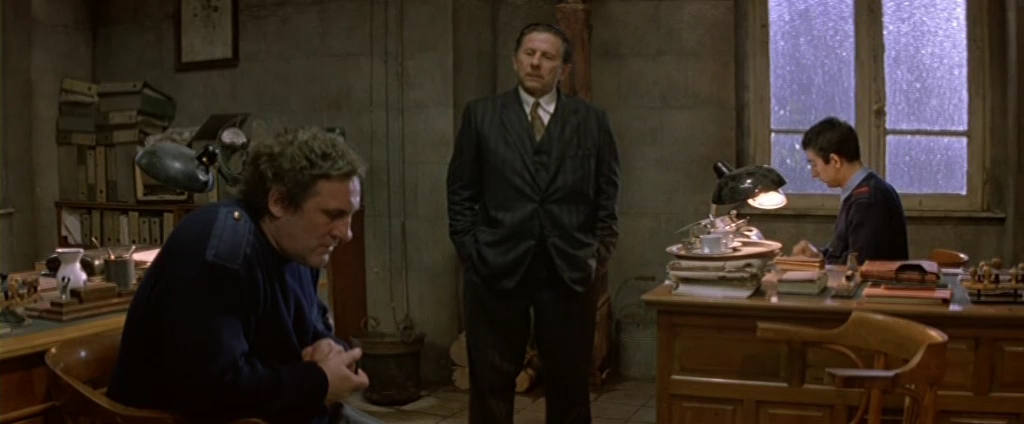
To begin with, it is written and directed by Giuseppe Tornatore, who gave us the Academy Award winner (in the Best Foreign Language Film category), Cinema Paradiso (1988) and the heartbreakingly beautiful coming-of-age story Malena (2000). Then comes the fact that A Pure Formality stars Gérard Depardieu, one of the most well-known faces of both French and international cinema. Moreover, it has Roman Polanski, a surefire entrant in any list on the acclaimed directors of our times—whose considerable genre-spanning body of work includes Chinatown (1974), Rosemary’s Baby (1968), The Tenant (1976), Death and the Maiden (1994), The Pianist (2002), and The Ghost Writer (2010)—this time in front of the camera. Another stalwart of Italian movies, who is equally revered in Hollywood, Ennio Morricone of Once Upon a Time in the West (1968), The Good, the Bad, and the Ugly (1966) and A Fistful of Dollar (1964) fame has composed the music for the film.

In a nutshell, A Pure Formality is a made by an Italian with a French actor and a Polish-French director in starring roles. In other words, it is a microcosm of world cinema. Ironically, when the world of cinema talks about any of the four doyens associated with it—Tornatore, Depardieu, Polanski or Morricone—one rarely comes across even a cursory mention of A Pure Formality. The irony is compounded by the fact that those who get the opportunity to source out this inexplicably ignored film find it to be pure pleasure to watch.

As a precursor to a journey that will be undertaken for almost the entire 108-minute duration of the film, A Pure Formality opens with a point-of-view sequence of someone trying to find a way through a dense forest on a dark, rainy night, after we, the viewer, have stared down the barrel of a gun moments before a bullet has been fired. The man (Depardieu), soaked to the skin, shoes caked with mud, and quite disoriented, is apprehended by a couple of policemen, who bring him to a ramshackle police station after he fails to produce any sort of identification. His earnest requests that he has an important meeting next day for which he will get late fall on deaf ears, when the captain of the station insists that he wait for the Inspector to arrive and ask him a few questions.

Once the Inspector (Polanski) makes his entry, the film becomes an engrossing tête-à-tête, during whose numerous twists and turns a mystery will be solved. But a few intriguing questions get answered almost as soon as the ‘interrogation’ begins. We learn that Depardieu’s character is, in fact, a renowned novelist named Onoff. Unfortunately, for Onoff, the realisation that the time when ‘people knew who I was before I even said “Hello”’ seems to have gone forever dawns when he finds that even though the Inspector is an ardent admirer of his work—to the extent that he can recite chunks of what Onoff wrote verbatim—he fails to recognize him at first. Maybe, it has something to do with the fact that Onoff’s characteristic thick beard is missing. Or is it because it has been six years, during which he has become a recluse, since he came out with his last published work?

But there are other more important questions that remain, and to the Inspector, it seems that Onoff can help in answering them. For example, the identification of a body, whose face has been badly mutilated, that has been discovered not far from Onoff’s farmhouse. Then, of course, there is that little niggling query about what Onoff was doing running around in such torrential rain, without an umbrella or a raincoat.

Onoff himself is quite apathetic to being interviewed. In his own words: ‘Interviews are pointless…Someone visits you to make you say what he already knows, for the pleasure of hearing you repeat it.’ Little does he or the viewer know that like a true writer he has phrased a truism, and that, too, unknowingly. As the conversation continues between the Inspector and Onoff, questions are faced with adamant opposition, contradictory information, and eventually an intense introspection. The outcome is as much a revelation for Onoff, as it is for us.

There are other films based on the premise of an interrogation. Examples include the Morgan Freeman and Gene Hackman starrer Under Suspicion (2000) and the Australian film The Interview (1998) which has Hugo Weaving in it. The pure pleasure of watching A Pure Formality does not lie in the fact that the film deals with the unraveling of an intricately crafted puzzle. But its enjoyment lies in the manner in which clues to the solution of the conundrum are laid out as the film progresses, similar to the bowls scattered across the floor of the decrepit police station to collect dripping water from the leaking roof. 

For almost the entire runtime of the film, there are only three characters on screen—Onoff, the Inspector, and Andre (Sergio Rubini), a young policeman, who has been entrusted with the job of transcribing the interview. The fourth character that ensconces these three is the rundown police station. There is a clock, but it has no hands, indicating time has all but stopped here. There is a phone, but we are told that the phone lines are the first casualty whenever there is a storm, implying estrangement from the rest of the world. And there is a cupboard, whose contents include important official documents, a few bottles of wine, a couple of glasses, and a mousetrap.

Each of these components of mise-en-scène comes into play as the film moves forward, but special mention needs to be made of the mousetrap, which is also an homage. It refers to the titular murder mystery written by Agatha Christie. Like the play, in A Pure Formality, a body has been found. While in the drama, four guests are forced to lodge in a guest house due to heavy snowfall; Onoff finds himself inside a dilapidated police station while it is raining cats and dogs. The guests in The Mousetrap are informed of a death by a detective sergeant; while it is from the Inspector that Onoff learns that a body has been found near his farmhouse. Most importantly, there is a twist ending in the play, as well as in A Pure Formality.

While Tornatore was gracious enough to strategically place an object of ode in his film, there are at least two directors, who have blatantly ripped off the crux of the story as well as some important plot points from him. Surprisingly, while both films are well known, one of these two went on to garner massive collections at the worldwide box office, while A Pure Formality till this day lingers in the shadows.

Just goes to show that life can be pure fatuity, at times.   


Sunday, April 17, 2011

A Tribute to the Triumphant Tramp


‘There is no essential difference between the material of comedy and tragedy. All depends on the point of view of the dramatist, which, by clever emphasis, he tries to make the point of view of his audience.’ — George P Baker

In the history of cinema, perhaps there is no singular instance of an artist who knew this truth more instinctively than Sir Charles Spencer Chaplin, or ‘Charlie’ Chaplin as he is fondly known. By poking at problems, and not confronting them squarely, this pint-sized pantomime artist made us laugh at the absurdity of it all, and revealed the universal truth that not only can the human condition be depicted better through comedy, but also that making the audience laugh is a better way to pontificate at a social malaise, rather than resorting to the power of the fist.

The term ‘comedy’ originates from the Greek word ‘kōmōidía’, which roughly translated means ‘to revel’ or ‘to amuse’. In its earliest form, comedy arose from the revels associated with the rites and rituals of Dionysus, the Greek god of grape harvest and wine. Today, when we see a Hindi film star donning the role of a standup comedian, while promoting a cellular service, it might seem an innovative idea. But very few of us would know that it was, in fact, Aristotle, who in his ‘Poetics’, written as long back as 335 BCE, had sown the seeds of the concept, when he stated that the foundations of comedy lay in improvisation.

In sync with its Greek roots, the classical definition of ‘comedy’ cites that its primary objective is ‘to amuse’. It has a ‘corrective’ motive, and it is based on truth, no matter how exaggerated. However, to make comedy effective, the foundation must always be believable. As Sir Peter Ustinov had once said, ‘Comedy is simply a funny way of being serious’.

Even though it is one of the most popular film genres, ‘comedy’ is unique as an art form simply because within that generic term lies a plethora of narrative structures. The most commonplace avatar of modern comedy involves a plot with the following plot points: boy meets girl, the two fall in love, and they unite after overcoming several obstacles. This age-old formula was made popular by doyens of literature like Shakespeare and George Bernard Shaw, and is till date keeping the wolf from the door for innumerable screenplay writers worldwide.

Next are ‘parody’ films. Stretched beyond its expiry-date today, in the form of a sub-genre called ‘spoof’, by the likes of the Wayans Brothers, Jason Friedberg, and Aaron Seltzer (Scary Movie series, Disaster Movie, Meet the Spartans), parody in cinema is essentially nothing but imitation—of the structure, style or subject of another film. Chaplin himself, in his early shorts, such as A Woman (1915) and Triple Trouble (1918) had taken recourse to parodies. 

The third variant of a comedy plot is reductio ad absurdum. In this, a social issue is reduced to a situation of chaos and utter absurdity. Perhaps the reason we laugh, when we see people making all sorts of wrong choices on screen and making all the errors of judgments possible is because all of these ring true—psychologically this is all very real. Chaplin’s Monsieur Verdoux (1947), which deals with a serial killer of rich women, is a classic example.

Then there is the narrative structure that draws a distinction between how people react differently to the same stimuli and similarly to different stimuli. Chaplin’s masterpiece The Great Dictator (1940) exemplifies this aspect by offering several perspectives—from a barber to the barbaric leader—to depict the interlinkages between human conduct and the social milieu.

The fifth structure of comedy films is characterised by a central figure—the protagonist. It is through his/her eyes that the viewer experiences both the main character’s and the other characters’ responses to the events that unfold as the film progresses. Chaplin’s iconic tramp, who was introduced in the short Kid Auto Races at Venice (1914) remained the central figure in all his films till Modern Times (1936), which, in its climax, had the tramp symbolically trudging down a long winding road towards the horizon.

Once Chaplin had famously stated that ‘All I need to make a comedy is a park, a policeman, and a pretty girl’. The genius that he was he knew that comedy, like music, is not dependent on the accoutrement, but on hitting the precise notes. And the tramp succeeded in doing just that. As depicted in what is now considered one of the—if not the—greatest comedy scene ever filmed, when he boils and eats a shoe in The Gold Rush (1925), while his companion keeps thinking he is a live chicken—no matter how bleak the circumstances and how towering the odds stacked against him, the tramp never accepted defeat. It appears as if the character had an in-built mechanism that forever prevented him from giving up. No wonder then, the tramp is the universal figure of comedy, without whose signature, the smile, the human society will find it extremely difficult to survive.

The timelessness of Chaplin lies in the fact that absolutely at the onset of his illustrious career he had realised that there is a thin line that separates laughter from pain, humour from hurt, and comedy from tragedy. He embodied these apparently antithetical aspects in the way he appeared as the tramp—a coat that is too tight, pants that are too loose, shoes that are too large, and a moustache that is too small. But just like his films that seamlessly combined tragedy with comedy, his appearance was a smorgasbord that flawlessly came together to create one of the most everlasting images depicted on celluloid.

Thus, even though the tramp remains one of the most oft-copied characters in filmdom and Chaplin the unacknowledged inspiration for millions even today, it is indeed disconcerting that the world decided to overlook that April 16 marked the birth anniversary of this timeless thespian. If we consider Jackie Gleason’s definition of comedy that states: ‘Comedy is the most exacting form of dramatic art, because it has an instant critic—laughter’, then the reaction that Chaplin continues to evoke from his audiences, irrespective of age, caste, colour, and creed, 97 years after the tramp made his first appearance on screen, bears testament to the fact that he is, and always will be, the master of comedy.

And for those acerbic critics, who will invariably point out Chaplin’s discomfort with ‘talkies’, the answer lies in a quote from an American comedienne, Elayne Boosler: ‘To listen to your own silence is the key to comedy.’

Sunday, April 10, 2011

A Subterranean Saga of Salvation


There comes a point in each of our lives, when we just cannot stand the sight of the profession we are employed in. But for Bulcsú (Sándor Csányi), the issue is slightly more complicated. As a ticket inspector of the Budapest Metro, his job is to kontroll, or to ensure that passengers have bought a ticket or at least have a valid pass. This apparently monotonous and innocuous job turns out to be a daily struggle, primarily because, with almost no exception, the passengers hate kontrollers and their job. In fact, they do so with such ferocity that the ticket inspectors face verbal—and even physical—abuse almost on a daily basis.

In this thankless livelihood, Bulcsú and his crew, comprising the elderly Professor (Zoltán Mucsi), the narcoleptic Muki (Csaba Pindroch), and Lecsó (Sándor Badár), who is afraid of dogs, has just been joined by the bumbling recruit Tibor (Zsolt Nagy). It is through Tibor, or Tibi, who acts as the surrogate for the viewer, that we learn that as if the incessant animosity of the Metro passengers was not enough, a prankster nicknamed Gyalogkakukk (Hungarian for the cartoon character Roadrunner), also known as Bootsie (Bence Mátyássy), who, apparently has eyes at the back of his head like the devil and can run like him, is making life hell for the kontrollers. On top of all this, there have been seven suicides, or jumpers who throw themselves in front of an onrushing subway train, this month alone. Later on, we realise that in most cases, it is a mysterious hooded figure that is pushing people on to the tracks.

Like the gigantic exhaust fan that we see Bulcsú perched upon in one shot of the film, each day in the life of our poker-faced protagonist is an endless cycle. Through a conversation with a passenger named Feri (János Kulka)—from whom Bulcsú hides the reality that he is now employed as a ticket inspector of the very Metro Feri is travelling in—we get to learn that Bulcsú had left a project that he was working on unfinished before he ‘went underground’. Bulcsú explains that he simply got weary of waking up everyday knowing that he had to wage a daily war to prove that he was the best in his work.

But deep down both Bulcsú and we, the viewer, know that the life he has consciously opted for is no better. While he has shut the world above by never venturing out into the sunlight, spending his days boarding one train after another and the nights by sleeping on the platform, he feels equally confined by his daily routine that never veers from waking up, working, and wandering off to sleep, and waking up again to engage in exactly the same sequence of events.

It seems the only time Bulcsú can feel any rush is when he competes in the perilous game of ‘railing’ with one of his rival kontrollers, Gonzó (Balázs Lázár). ‘Railing’ is like Russian roulette. Only difference being it is a footrace and does not involve a revolver, though the stakes are equally high. When the last passenger train leaves, those who are participating in ‘railing’ run after it, following the serpentine tracks. But the objective is not to catch the train ahead of them, but to avoid getting crushed by the ‘midnight express’, the last train that comes after the final passenger train, which never stops at any station, and is always breathing down their necks, and is hot on their heels.

The ‘midnight express’ is nothing but a personification of the past that Bulcsú is running from. That is why, even though he has made a name for himself as a ‘railing’ champion, even after winning another race, his face is not flush with the exhilaration of victory, but cringed with an aura of defeat.

One day, into this dreary life of Bulcsú, appears Szofi (Eszter Balla), a girl in a teddy bear suit. She is the daughter of Béla (Lajos Kovács), who, after being banished from the world above when he could not stop in time because of ‘insufficient braking distance’ now drives one of the subway trains of Budapest Metro. Like the Little Bear constellation, Szofi takes on the role of a guiding star, lighting up Bulcsú’s humdrum existence. For the first time in a long while, Bulcsú starts thinking beyond the frequent fights with the commuters, the boring conversations with his crew members, the menace posed by Bootsie, and the perilous hooded figure.

It is difficult to categorise Kontroll (2003), the first feature length film by the Hungarian filmmaker Nimród Antal. Like its characters who hop, skip, and jump over railway tracks while ‘railing’, the film deftly hopscotches across several genres—drama, mystery, thriller, comedy, and even romance. Filmed in its entirety in a subterranean setting, the brooding atmosphere is lightened both by individual character traits (like Muki collapsing into a narcoleptic fit every time his temper rises) and by the interactions of the kontrollers with passengers without tickets, which vary from the benign (a stuttering man trying in vain to explain his situation) to the bizarre (being handed a lottery ticket in place of a subway ticket; being threatened by a gypsy that she will put a curse on the inspector who had the gall to ask for a ticket; to a guy pulling out a syringe full of blood and wielding it as a weapon).

Kontroll was selected to be a part of the Un Certain Regard category of the Cannes Film Festival in 2004—two decades after the last Hungarian film made it to the prestigious event. Not a small feat by a director making his full-length feature film debut, by any means. Thus, one would have been perfectly justified to hope that the four sets of escalators all moving upward in the final shot of Kontroll would also signify the rise of this talented born-of-Hungarian-parents but raised-in-Los-Angeles filmmaker. Unfortunately, his career graph, since then, has resembled not the final, but the opening shot of Kontroll, wherein all the escalators are seen moving down. The clue possibly lies in the fact that he never went back to his homeland again but decided to heed the call of Hollywood instead for his next three films: the vacuous horror flick Vacancy (2003), the atrocious heist movie Armored (2009), and the pathetic sci-fi offering Predators (2010).

Sunday, April 3, 2011

Learning Life’s Lesson


As the 13-year old-students of an unnamed Japanese junior-high school get ready for the bell to ring and announce the end of term, storm clouds are gathering outside, foretelling an impending doom. When their teacher Yuko Moriguchi (Takako Matsu) starts addressing them, the boisterous, rowdy, and unruly bunch is seen hardly paying any attention to her words—some of them are sleepy, some are busy texting on ubiquitous cell phones, some generally spaced out, while others are obviously bored and disinterested in what their teacher has to say.

As oblivious they are to the monotonous monologue of their teacher, it seems Moriguchi is equally unmindful of the cacophony around her, as she starts her address that begins innocuously enough, but gradually builds up to a terrifying conclusion.


Like the students, we, the viewer, too, are initially unaware of exactly where she is going with her monologue as it sifts through apparently unrelated topics, while the camera snakes through students, benches, and the nooks and crannies of the classroom. But like the thunderheads gathering outside, as time passes by, her words take on a more and more ominous shade; and similar to the students in the class, we, too, find our curiosity piqued and attention captured. After all, it is unlike any farewell speech ever delivered by a teacher, who has just resigned from her post and addressing her class the last time.

By the time Moriguchi’s half-hour-long monologue ends, the seemingly disparate aspects of her speech fall in place like an elaborately crafted jigsaw, threading together the answers to the following questions: Why was she referring to Masayoshi Sakuramiya, well-known for his brilliant book, who had travelled the world before becoming a passionate teacher, and was diagnosed with a terminal illness just a month ago? What was the significance of Moriguchi insisting that anytime one of her students asks for her after school hours, she would invariably send a male teacher, instead? Why was she speaking about the health checkups once the next term begins, while handing out cartons of milk to the entire class, if she would be gone by that time, anyway? What did she mean by saying that the death of her four-year-old daughter Manami was not an accident, as the ensuing police investigation had revealed, when she was found floating on the swimming pool inside the school? And who are the two boys of the very class she was addressing, who, she says, had in fact murdered Manami in cold blood? Most importantly, what is it exactly she wants with those two boys?

The first half-an-hour of Tetsuya Nakashima’s Kokuhaku aka Confessions (2010) has more twists, turns, and surprises than most films manage to fit in into their entire runtime. And after such a breathless start, one would expect the film to lose its momentum thereon. But here, too, Nakashima’s film, based on a bestselling novel by Kanae Minato, proves us wrong. Like a clock that we see on screen a number of times, the film meticulously surges ahead, keeping us wondering with every ticking moment what Moriguchi’s painstakingly crafted plan for revenge has in store for the two implicated individuals—the athletics aficionado Naoki Shimamura (Kaoru Fujiwara) and the electronics prodigy Shuuya Watanabe (Yukito Nishii).

Moriguchi, as we come to learn, is more than just an avenging angel. Her intention is to make the two perpetrators realise the severity of the crime she believes they have committed, and make them come to terms with the importance of life itself.

Similarly, the film is not merely a revenge drama. It is a critique of the Japanese legal system, specifically, Article 41 of the Penal Code, which stipulates that those under 14 years of age are not liable for the crimes they commit, and hence, cannot be punished as a result; a treatise on the desire youngsters have to be recognised; a commentary on how most parents are completely ignorant of how to reach out to their kids; a condemnation of how majority of parents impose their own dreams on their children, unaware of the detrimental effect it can have on those young minds; a denunciation of how gadgets, while being designed to keep them connected have actually succeeded in alienating the young generation from their peers; and an impeachment of how impressionable young minds are always in the quest for an idol to emulate, and the extent to which that blind faith can be exploited.

Intricately structured akin to the novel it is based on—divided into five confessions—Kokuhaku is a frightening depiction of teenage group dynamics, peer pressure, and the angst of adolescence. It is, indeed rare to come across a film where the audience finds it difficult to take sides with any of the characters on screen, simply because each one of them is irredeemable. It is with immense gusto that Nakashima has pulled this one off. His mastery of the craft is evident in the way he has used the red-and-white milk cartons as harbingers of a horrific plot point; the introduction of fish-eye lenses to invoke the idea that there is more to what is being viewed than what the normal eye can see; a cleaver chopping off an electronic toy resulting in a splatter of its mechanical body parts like blood spurting out of a human body being butchered; the uneasy screech of the chalk on the board as Moriguchi writes ‘life’ on it; Moriguchi opening a window, while allowing her class to know a particular secret in her life and then shutting it as soon as she has finished relating it, as well as Nakashima’s poignant portrayal of the attention-craving, loneliness, and rejection that adolescents find so difficult to cope with.

During her address, Moriguchi had revealed that as a teacher, she chose to ‘do my best to place myself on the same level as the students’. In her quest to avenge her daughter’s death, not only did she stay true to her word, but also meted out a lesson that would last a lifetime and scar the two perpetrators forever.

Japan’s official selection in the Best Foreign Film category at the 83rd Annual Academy Awards, it is quite apparent why this searing tale of adolescent anomie did not make it to the top five. The ease with which Japan tackles the harsh reality of life, be it on screen or off it, is conspicuous by its absence in mainstream Hollywood. And having an ambiguous conclusion to a situation that Hollywood chooses to forsake rather than face did not help the film’s cause, either.

This is one of the many life’s lessons that the American film industry, which is still in its puberty when it comes to confronting the cruel side of growing up is concerned, needs to learn, fast.