Saturday, August 13, 2011

Fear, Fiends, and Family


In Wes Craven’s Scream (1996)—a simultaneous satire of and salute to the then-fledgling horror genre—a character prided himself of knowing all the unwritten rules of horror films. One of those principles should definitely be ‘Scare the audience precisely when they are feeling safe’. And if there is one place where every individual feels secure, it has to be his/her home. After all, there is even an idiom in English: ‘as safe as houses’.

The ‘home invasion’ sub-genre of horror films subverts this saying. While most haunted house films’ basic premise lies in the living violating the estate of the dead; in ‘home invasion’ films, the act of trespassing invariably occurs on the property of the living, and that, too, by the living. Also, more often than not, such films bring to the fore the latent beast within us all. It is as if to imply that a sense of territoriality is not a characteristic merely of animals, but of man, as well.

Each one of us, to some degree or the other, harbours a fear of burglars. There is even a scientific term for it: scelerophobia. But in ‘home invasion’ films, it is not a family’s jewels, which are at stake. In fact, the stakes are way higher. In Miguel Ángel Vivas’ second feature Secuestrados (2010) a.k.a Kidnapped; it is an entire family of three that is at peril.

Though we never really get to learn what he does for a living or his surname, it is quite obvious that Jaime (Fernando Cayo, who starred in Juan Antonio Bayona’s superb El Orfanato [2007], and will be seen very soon in Pedro Almodovar’s latest offering The Skin I Live In) is doing very well for himself. Along with his wife Marta (Ana Wagener) and teenage daughter Isa (Manuela Vellés), he has just shifted into an impressive house, replete with their own swimming pool, located within a gated community.

To celebrate the first dinner together as a family at their new residence, Marta has arranged for a bottle of champagne. But Isa has other ideas. Like most other eighteen-year olds, rather than spending time with her parents, she would prefer, instead, to go to a party with her boyfriend César. Moreover, as Jaime realises, Isa is having trouble adjusting to her new surroundings, which she labels as a ‘graveyard’—a term that, unknown to her, portends to what is about to follow.

During the first quarter of an hour of this 85-minute film, we observe an almost incessant argument between Marta and Isa. Marta is, we get to learn, quite fond of César. But just for that particular day, she would rather have her daughter stay with her than go out with her fiancé. When her initial cajoling and coaxing fail to have any effect on the adamant Isa, Marta sternly puts her foot down; even insisting that Jaime would side with her in this argument. However, to her utter chagrin, Jaime approves of Isa’s idea, and therein begins another squabble—this time between husband and wife.

In other words, we witness a mother trying to gather her family together for one ‘special’ dinner, and failing miserably to get across to her rebellious daughter. Her husband, on the other hand, is a lot more concerned with whether a gum boil is making its reappearance inside his mouth than playing peacemaker. Little did Jaime know that very soon he will have a lot more to be concerned about. Nor was Marta aware that her wish of Isa forsaking the party for the sake of her family will come true, but in a manner she could never have imagined.

As the couple find themselves drained out at the end of a really long day, and try to figure out apparently mundane but important issues like how to persuade the plumbers to ensure continuous supply of hot water in the bathroom or getting the Internet up and running soon, three Albanian men, with their faces hidden behind ski masks force their way into the house.

Now huddled on a sofa than at a dining table, the family members are forced to hand over all their debit cards and reveal the ATM PIN of each. When Jaime tries to outwit the leader of the burglars— when asked to reveal the whereabouts of his cell phone—we realise the masked intruders cannot be outsmarted easily. They put a plastic bag around Marta’s head and try to suffocate her as a warning to Jaime not to try such tricks again. If the opening sequence of the film was any indication, we know, but Jaime does not, that the trio are not amateurs—but pros in the act of breaking into houses and breaking the spirit of their residents.

‘I like to have things easy’ reveals the leader to Jaime. But, inevitably, things get complicated—both for the robbers and for the family. Complications arise when one of the three criminals, in a fit of rage, decides to disobey his boss’ orders. The goings-on get even murkier when a security guard arrives at the doorstep, acting on the neighbours’ complaints of hearing screams emerging from Jaime’s house. As the initial plan of the burglars begins to get completely messed up, Secuestrados builds up to a climax that is both depressing and disconcerting.

Forty-four years ago, Terence Young had a sinister and cold-blooded Alan Arkin and two other thugs terrorise a visually impaired Audrey Hepburn in her apartment in Wait until Dark, thereby sowing the seeds for a new tenet: ‘Home is where the hurt is’. Since then, this horror sub-genre has been visited by a number of famous directors (Sam Peckinpah: Straw Dogs [1971]; Michael Haneke: Funny Games [1997 and 2007]; and David Fincher: Panic Room [2002]). As they subvert one of mankind’s basic beliefs—that of the home being safe—these films are often unapologetically brutal. Cases in point are Angst (1983), a German film whose camerawork has had a profound impact on the notorious Argentine filmmaker Gaspar Noé; Hard Candy (2005), where Ellen Page went on a rampage; the Romanian film Ils (2006) and its Hollywood remake The Strangers (2008)—both of which had a brilliant twist in the tail; and the French film Á l’intérieur (2007) that pushed the envelope quite far when it comes to gore and violence.
 
There are shades of almost all these films in Secuestrados. The hooded intruders of Ils, the saving the honour aspect of Straw Dogs, the element of brutality towards an older woman of Angst, the mother-daughter relation of Panic Room, and the cowering bloodied image of a female from Á l’intérieur. Even an infamous scene from Noé’s Irreversible (2002) makes an appearance. While the ‘breaking the fourth wall’ element of Funny Games is missing, Vivas has tried to break new grounds in the subgenre by having only a dozen shots in the film, and by introducing interesting techniques like split screens to depict simultaneous action.

With Hollywood deciding to (yet again) unnecessarily remake Straw Dogs; it seems we no longer need to visit a haunted house to be scared. Because horror is making a lot of house calls these days.

Sunday, August 7, 2011

Cops, Crime, and Clairvoyance


The annals of world cinema are replete with examples of teaming ups between an actor and a director. From F W Murnau and Emile Jannings, Akira Kurosawa and Toshiro Mifune, Ingmar Bergman and Max von Sydow, Sergio Leone and Clint Eastwood, John Woo and Chow Yun-Fat, Werner Herzog and Klaus Kinski, John Ford and John Wayne, Martin Scorsese and Robert De Niro, Steven Soderbergh and George Clooney; to our very own Satyajit Ray and Soumitra Chatterjee, Manmohan Desai/Prakash Mehra and Amitabh Bachchan, and Karan Johar and Shahrukh Khan—the list is always a work in progress. Equally rare are instances of director duos, who are not siblings. Johnnie To and Wai Ka-Fai from Hong Kong belong to that sparsely populated elite club of collaborating directors, who are filmically, and not fraternally, connected to one another.

Another interesting aspect of the To-Wai collaboration—as many as eleven out of the seventeen films that Wai has directed till date have To as co-director—is that more often than not, the films have had a supernatural element woven into the plot. Cases in point are: My Left Eye Sees Ghosts (2002), in which a young woman develops the ability to see ghosts after a car accident and Running on Karma (2003), where a monk-turned-bodybuilder finds he has the power to look into people’s lives.

As the opening credits of San Taam (2007) a.k.a Mad Detective—their latest outing together—start rolling, with all the letters appearing in an angular manner, we get the first impression that what is about to follow will be anything but straightforward. That feeling is fortified when we are introduced to the titular character, an inspector of West Kowloon’s District Crime Division, Chan Kwai Bun (portrayed by Lau Ching-Wan—a favourite of Johnnie To, who has featured in several of the director’s films, including A Hero Never Dies [1998]; Where a Good Man Goes [1999]; and Running out of Time [1999]).

Many films have a character who acts as a proxy or surrogate for the audience (Ariadne in Nolan’s Inception, for instance). In San Taam, inspector Ho Ka-On (played by Andy On), a new joinee in Bun's department, acts as the audience’s eyes and ears. It is via him that we are introduced to the oddball Bun, who, we are told is in the middle of an investigation that involves cracking the case of a student’s body being found inside a suitcase. To the utter dismay of both us and Ho, Bun climbs into a suitcase and requests the greenhorn detective to zip it and push it down the stairs. As soon as the suitcase reaches the end of the staircase, out emerges Bun, screaming ‘The ice-cream shop owner is the killer’, as if struck by an epiphany!

Flashes of newspaper headlines make it amply clear to us that irrespective of how zany and unorthodox his methods are Bun has an excellent record in solving criminal cases. But unlike other times, when his colleagues actually requested him to put his uncanny knack for the unconventional to use, the department decided he had gone too far the day he offered a farewell present to the retiring chief that—for want of a better term—can only be called ‘Van Gogh-ish’.

Five years pass by. Banished from the force, one day, the loon from Kowloon finds a visitor at his doorstep. It is none other than Ho. Initially reluctant to even speak with Ho, Bun’s interest gets piqued when Ho tells him that even though he had worked with him for only two days, he considers Bun to be his idol. In fact, when Ho’s gun developed a defect, he was given a new one—Bun’s. And it is a gun that forms an integral part of a case that Ho is now in charge of—a case in which he wants Bun’s help.

The extent to which Bun’s nickname suits him becomes apparent once he revisits the department that he was once the pride of. During the briefing session on the case for which his assistance has been sought, both Ho and us get to learn that Bun has a special ability—that of seeing the inner demons of a person.

It is here that To and Wai have displayed their finesse as filmmakers. What Bun sees in a person is different aspects of the same self, but as separate individuals—can even be of different sex—each with distinct nature and objectives. While this preposterous plot point is taken with more than a pinch of salt by both Ho and us, gradually, as the film progresses, we warm up both to this suited-booted-sans-socks oddity and his frequent ‘visions’.

And just when we find ourselves at ease with Bun’s philosophy (‘Apply emotions to investigate, not logic’) and the methods behind his madness (which includes using his index finger as a pistol as he recreates each crime scene, a request to be buried alive, and ordering the same dishes again and again at a restaurant), like master storytellers, To and Wai plant a seed of doubt in our minds. We are left to wonder if Ho’s quirkiness is nothing but evidence of a mind in complete disarray.

While some of us might point out ‘The more complicated the story, the better for us’—a line spoken by a character in San Taam as a description of the film itself; especially in the context of the convoluted climax that is equal parts The Lady from Shanghai (1947) and Enter the Dragon (1973), the film is a success in the sense that it makes us question where exactly sanity ends and insanity begins—a point brought to the fore by the translation of the film’s title. The literal English translation of San Taam is ‘godly detective’, while the international title is ‘mad detective’ proving once again that there is indeed a very thin line between being a seer and being sneered at.

Sunday, July 31, 2011

Fate, Fascination, and Fortitude


The renowned British playwright Tom Stoppard had once remarked: A movie camera is like having someone you have a crush on watching you from afar—you pretend it's not there.In Le Fils  a.k.a. The Son (2002), a film by the Belgian director-writer duo, brothers Jean-Pierre Dardenne and Luc Dardenne, the camera is more like the gaze of a smitten lover—unflinching and unwavering to the point of being almost unbearable.

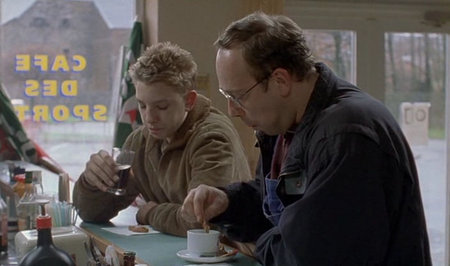
With their grounding in documentary filmmaking, in the hands of the brothers, the camera seems to have taken a life of its own—prodding, prying, and perceiving the dreary, day-to-day dealings of Olivier (a role that fetched Olivier Gourmet, the perennial favourite of the Dardenne siblings, the Best Actor award at the 2002 Cannes Film Festival), a carpentry instructor at a vocational rehabilitation establishment in Liège, Belgium.
However, even though the Dardennes have filmed Le Fils using a handheld camera, their approach is not that of the ‘queasy-cam’; nor is it the point-of-view style, which is the current fad among filmmakers. Instead, the shots are mostly over-the-shoulder of Olivier, so that the camera sees what Olivier does, rather than acting as an expository element.
At the beginning of the film, during the few occasions that we get to see his face, we find the bespectacled Olivier to be an expressionless and sullen individual. Meticulous in his craft, as all good carpenters should be, he gruffly reprimands his four students—Raoul, Steve, Omar, and Philippo—whenever they fail to stick to the basic tenets of carpentry. The hammering of nails, whirring of power tools, and other ambient sounds of a carpentry workshop fill up our ears from the moment the film opens. To accentuate Olivier’s dull existence, the Dardennes have completely done away with a background score. It is as if to signify that like the unseen camera that hovers around his back or the wooden beams that he is sometimes seen balancing on his shoulder, Olivier is carrying a burden—a burden that has the potential to completely mess up the life of this otherwise careful, meticulous man.

While Olivier checks the measurements taken by his students, instructs them to plug gaps between pieces of wood, and shows them how to use the various tools of the trade, one gets the feeling that this ever-watchful individual is equally fastidious about not letting his guard down. One cannot but help think that the attention to detail is but a façade, cultivated to keep in place a secret simmering deep inside.

Always in motion, keeping his hands busy forever, Olivier’s continuous movement is quite akin to that of an animal in captivity. His only way of letting out steam is to do pushups within the confines of the four walls of his dingy apartment. But then again, that act might not be to alleviate the pain he feels deep within, but to soothe the muscles of his lower back.

A man who does not reveal an iota of emotion when his estranged wife arrives at his doorstep to tell him that she is getting remarried and is also carrying a child in her womb, suddenly springs to action when he is handed the file of a young boy, Francis (Morgan Marinne) who wants to join his carpentry section. Initially reluctant and dismissive, soon Olivier starts following Francis, both inside the vocational facility, and out of it. He steals his keys, breaks into his room, and even lies down on his bed. Little by little, we learn about the blow fate has dealt to Olivier. Slowly, but surely, we also fathom the reason behind the man’s growing fascination about who the boy is and what he does.

It is precisely then that every movement of this cautious carpenter takes on a completely different dimension. Contrary to the pre-determined method that determines how two pieces of wood fall in place, we, the viewer—now privy to Olivier’s secret—are left to wonder what the outcome of each of his moves will be. The total lack of any expository dialogue and the absence of any back story make the task all the more difficult for us.

Francis, though, is completely oblivious of how his life is connected to that of Olivier. This uneven equation is made even more apparent by the symmetry that is such an inherent aspect of the profession of carpentry. Francis is, however, in awe of Olivier’s acumen of using his eyes as a measuring tape. Even though Olivier is barely civil towards the sixteen-year-old—he refuses to pay for his food, nor does he shake his hand—an unspoken understanding starts growing between these two equally quiet individuals, step by step, in sync with the carpenter’s character.

Then, one day, Olivier extends an invitation to Francis to accompany him during the weekend on a long drive to a timber yard. The objective is to understand various types of wood, he says. But we, the viewer, because of what we know and Francis does not, fear for him. And we pray that for once this man, who has an innate ability to make the correct decision when it comes to a dead piece of wood, displays the same judgment in the case of life, as well.

A film that says as much with an actor’s body as one blow of a carpenter talks of his talent, Le Fils, while staying true to the ‘Belgian lower-class life’ template that the Dardenne brothers are famous for, has at its core a simple truth with universal appeal.  Inevitably, most of us will not miss the obvious comparison between Olivier and the most revered carpenter of all, but the essence of this truly minimalist film lies in the carpenter’s rule: ‘Measure twice; cut once.' 


Sunday, July 24, 2011

Perception, Pretension, and Prevarication


 Filmmakers’ predilection towards exotic ailments has quite a long history. From Alfred Hitchcock (the eponymous Vertigo, 1958), Christopher Nolan (short-term memory loss in Memento, 2000) to our very own R Balki (progeria in Paa, 2009) various directors have portrayed mysterious maladies in movies with varying results. At first glance, Eugenio Mira’s second full-length feature, the Spanish film Agnosia (2010)—a similar bizarre medical condition in which an individual’s brain loses the ability to process visual, aural, and olfactory stimuli—seems to be a mere addition to this fascination of filmmakers. But curiously enough, drawing that conclusion would be a perceptual error on the part of the viewer. Because Agnosia treats the travail and trauma of a character suffering from the titular affliction merely as a plot point to drive the story forward. As a film it is a period piece, costume drama, triangular romance, and an espionage thriller rolled into one.

Even though the genre-mashing characteristic of Agnosia will become evident to the viewer when s/he is well into its 106-minute running time, the opening sequence makes it amply clear in an instant that what is about to unfold on screen is a sumptuous treat for the eyes. As the story comes to life, Unax Mendía’s (who was also the cinematographer for Mira’s debut feature The Birthday in 2004) camera opens on a valley enveloped within the Great Pyrenees mountains. The year, we are informed, is 1892. The setting, replete with a stage with curtains drawn, a ramp, and vacant chairs arranged in rows gives the impression of a performance about to commence—auguring an important element of the tale.

As the guests, all military officers, arrive in horse-drawn carriages, we find that they have been invited to witness the working of a new invention by an engineer, Artur Prats (Sergi Mateu), employed with the Holbien industries, which has been manufacturing ‘the best weapons’ for many years. The item on display is a catadioptric lens (a mirror lens known for its focusing capabilities) that can be used as a sniper scope. Helping Prats is his little daughter, Joana, who has been entrusted with the responsibility of releasing a bunch of black balloons, which the military officials shoot as targets while looking through the sniper scope.

A visibly distressed Joana becomes even more distraught at the cracks of the rifle, her anguish amplified by the neighing of a horse, which bolts at the sound of the gunshots. When one of the officials shifts his focus and shoots down the animal instead, Joana faints, hitting her head as she falls. As Prats’ assistant Carles Lardin (Eduardo Noriega, nicknamed the ‘Spanish Brad Pitt’, who has acted in films by Alejandro Amenábar, Brad Anderson, and Guillermo del Toro) comes to her rescue, to his utter dismay, he finds that Joana is having trouble distinguishing him from her father. This, coupled with the stage-drama like setting, are nothing but a foretelling of the tale that is about to unfold. If the bursting of the black balloons portended to the dark world Joana will be plunged into, the breaking of the glass of the sniper scope symbolised the shattering of Artur’s dream—both as a parent and a professional.

Seven years pass by. In the meantime, Artur has parted ways with his employer, Lucille Prevert (the prolific German actress Martina Gedeck, whose filmography includes The Good Shepherd and the Academy Award winner The Lives of Others—both in 2006; and The Baader Meinhof Complex in 2008) and has set up his own company, Joana Lenses, with Carles.

Artur treats Carles more as a son than a business partner, and has even promised Joana’s hand to him in marriage. When we first meet the adult Joana (Bárbara Goenaga), we hear her saying she is not comfortable wearing her mother’s clothes. It seems discomfiture has become a way of her life since that tragic incident at the valley. Fate has played a cruel game on Artur as well. A man who manufactures lenses for a living has been left behind with a daughter who cannot even perceive the faces of her close ones, even when they are at an arm’s length. The guilt-ridden Artur, disregarding the fact that his business is going through a rough patch, has employed a doctor, Meissner (Jack Taylor) to cure Joana, on whose methods Carles has very little faith.

The two ways in which we, humans, react to a disorder as strange as the one Joana is suffering from are expressed by two different sets of individuals in Joana’s household. While Carles, though outwardly devoted to Joana, is inwardly aloof; the servants, especially one individual named Mariano—begrudged by the fact that they have to wear different-coloured rosettes, because colour is one of the few stimuli Joana still reacts to—make fun of her.

But, Carles, Artur, and Joana are all unaware that a nefarious ploy is afoot, that will very soon engulf all three lives. It is a plan set in motion by Artur’s former employer, the ruthless Prevert, to extract the formula of the sniper scope—a secret, she believes, is in Joana’s possession. To attain her objective, Prevert plants a spy, Vicent (Félix Gómez), in the guise of a man servant in Artur’s residence. But when Vicent gets inadvertently fired from his job, he is sent back on his mission. Only this time, the plan is to exploit Joana’s malady in a manner reminiscent of Kurosawa’s Kagemusha (1980).

Three days are all that Vicent has at his disposal to coax the formula out of Joana—the period during which Joana will be completely isolated from all stimuli, while being cocooned inside a dark, sound-proofed room, as part of Dr Meissner’s last-ditch attempt to heal her.

But just like the darkest hour is always before dawn, a ray of light will invigorate Joana during those three days. She will, for the first time in a long time, feel as if those distant stars in the sky—the only thing in the world she could see in the same manner as any other individual—have landed inside that dark room, while being ignorant of the fact that she is, in reality, becoming a pawn in a game of deception.

Even though the perpetrators of this reprehensible charade take every precaution, they find themselves completely unprepared by the opposition they come face-to-face with. The adversary in this case is nothing but love—passion that arises from completely unexpected quarters and threatens to jeopardise their elaborate sham. 

In an interview, Mira had stated that the reason he chose nineteenth-century Spain as the setting for his film is because modern technology has nullified many of the problems that Joana faces in the film as a result of her ailment. But it is quite apparent that there are certain aspects of human nature that is not bound by any era, period or millennium. Each one of us harbours a secret; our love for another individual is not holistic and all-encompassing, but pigeon-holed to a specific aspect of him or her; and that in the end true love is all about sacrifice—putting the other’s happiness before that of our own. 


Sunday, July 17, 2011

Love in the Life of a Lugubrious Loner


 The title of the young Italian writer-director Paolo Sorrentino’s second feature film, Le Conseguenze Dell’Amore (The Consequences of Love), released in 2004, does have a Bergman-like feel to it. But the ethereally beautiful opening shot is more Kubrick-ish, Tarkovsky-esque, and a la Leone.

In a sterile white interior, a lone figure appears on screen, in extreme long shot, riding a travelator moving in a snail’s pace, with a suitcase beside him. Even though we are yet to meet the film’s protagonist, that single long take presages a lot about him. In one deft touch, Sorrentino tells us we are about to encounter loneliness, an ascetic existence, and a life that appears to have transformed into an automaton so much so that it needs external assistance even in moving along.

When we do meet the protagonist, Titta di Girolamo (a brilliantly understated and restrained performance by the noted Italian theatre director and actor, Toni Servillo), seated at the lobby of a plush hotel in Lugano, Switzerland, a voice-over tells us ‘I am not a frivolous man’. That declaration can be considered redundant. For one glance at this stoic, scowling, sartorially elegant bespectacled and balding man, cigarette in hand, with his back half turned towards us and towards life, is all that it takes to make us realise the same.

Sorrentino also introduces us to Sofia (played by Olivia Magnani, granddaughter of the legendary Italian actress Anna Magnani, who had starred in films by Roberto Rossellini and Pier Paolo Pasolini, among others), who works as a maid at the hotel’s bar. When we first lay our eyes on the young Sofia, she has a shaker in her hand, symbolising that soon she will be shaking up someone’s placid personality.

For one brief moment, we believe that these two character’s eyes have met—thereby materialising a connection that we can feel palpably—only to find that she is staring at a horse-drawn hearse through the lobby window. While the shot at the travelator set the scene for the film, the hearse, as we shall find out, portends to its conclusion.

Titta seems to have little regard for the saying: ‘Solitude is a good place to visit, but a bad place to stay in’. While to most of us, a hotel is our temporary abode, for this non-descript, taciturn, insomniac from Salerno in south-western Italy, a hotel room has been his home for eight long years.

His routine is as unwavering as his suits are impeccable. For six days a week, he sits at a corner table in the hotel lobby, observing the various guests at the hotel, ignoring interaction with any other individual, except when forced to do so. Titta is a man who has become so unaccustomed to living that when he is forced to converse with someone else, he peppers his sentences with philosophical ditties, while avoiding any reply that would throw light on his life by stating ‘The truth, my friend, is boring.’ Only for a day every week, does he leave his gilded cage, carrying with him a bag full of money to the bank. Ironically, for a man who steers clear of all sort of human interaction, at the bank he insists that the money be counted by hand, and not by a machine, stating that ‘We must never lose faith in our fellow men’.

Rude to the point of brushing aside a chambermaid’s polite queries with stern silence, we find Titta in others’ company only when he is sharing the table with hotel hermits like him, playing a game of cards. Two of his fellow players are Carlo (Raffaele Pisu) and his wife Isabella (Angela Goodwin)—the former owners of the same hotel. Due to Carlo’s gambling habits they have lost it all and have now been relegated to only a room in the establishment.

Like every man, Titta, too, has a few ‘unmentionable secrets’ in his life. One secret is that every night he eavesdrops on the conversations of Carlo and Isabella—by placing a stethoscope on their common door—hearing Carlo lamenting the spectacular life they once led and wishing for a spectacular death. There are two more secrets—one regarding the origin of the suitcase full of money and the other about a particular habit that Titta has cultivated for more than two decades.

Titta’s monotonous, meticulous, and morbid non-life is shaken to the core the day a visibly upset Sofia approaches his table and demands an answer as to why for two long years he has refrained from responding to her ‘Arrivederci’s (goodbye). The question whether he even acknowledges the fact that she exists seems to rattle Titta’s own existence of anonymity. That is when we see a faint smile on his face for the first time. Later, when he perches himself on a bar stool and tells Sofia that it is one of the most ‘dangerous’ things he has ever done, we, too, like her cannot suppress a smile.

The two go out shopping, he buys her an extravagant gift with the sole purpose of taking their relationship to the next level, and they even have a lovers’ tiff. A man who firmly believes in the saying that once someone knows a secret, it isn’t a secret any more finds himself spilling his darkest secrets to Sofia without even batting an eyelid. As he and Sofia seem to be coming closer, we find Carlo and Isabella drifting apart after Titta catches him cheating at cards.

But like all great love stories, fate will intervene in Titta’s tale. In a turn of events that will involve a missing suitcase containing nine million dollars, the Mafia, and hit men, Titta transforms himself from a man devoid of any imagination to one who can outwit even a seasoned Mafia boss.

Though the preceding paragraph seems to indicate that Le Conseguenze Dell’Amore ultimately ends up being a clichéd Italian film full of stereotypical characters and scenario, it actually avoids any such pitfalls.

It is in fact, an existential tragedy, encapsulated by that shot of Titta looking through his hotel room window at a passerby below, who, while engrossed at staring at a female runs straight into a lamppost. It is also, as the title suggests a story of love. Not the usual ‘romantic love’ that we are spoon fed by soppy Hollywood romances, but the love ‘The Fab Four’ from Liverpool spoke about in their song called ‘The End’—‘…and in the end, the love you take is equal to the love you make’.


Sunday, July 10, 2011

Interrogation, Investigation, and Impressions


In one of his many interviews, Alfred Hitchcock had famously stated, ‘I enjoy playing the audience like a piano.’ The maestro would have loved the tune composed by the Australian film director Craig Monahan in his debut feature, The Interview (1998).

The film begins with a Kafkaesque nightmarish situation, with Eddie Rodney Fleming (Hugo Weaving, who played Keanu Reeves’ nemesis, Agent Smith, in the path breaking The Matrix, a year later), an out-on-the-dole individual, who has lost both his job and family, is rudely awakened from his slumber at five in the morning, when two armed policemen barge through the door of his unkempt, one-room apartment. Disoriented, dumbfounded, and distraught, Fleming’s repeated pleas of innocence fall into deaf ears as the cops ransack his apartment, physically and verbally humiliate him, and then at gunpoint, against his will, take him to the station for the eponymous interview (the Australian equivalent of a police interrogation, where questions are asked in order to find out the truth about an incident).

One of the cops who forcibly take Fleming into custody is Detective Sergeant John Steele (Tony Martin), who has been called in ‘to get results’. He is an official with a penchant for throwing away the rulebook—a habit, which has led to his having several run-ins with the Ethics Standard Department (the Australian equivalent of the US’ Internal Affairs) over the past few years. His younger aide is Detective Senior Constable Wayne Prior (Aaron Jeffrey, who portrayed the character of Thomas Logan in 2009’s damp squib X-Men Origins: Wolverine), who has a tendency to burst into unprovoked violence.

The clueless Fleming is shoved inside a dank, dingy room filled only with a couple of chairs and a table with a tape recorder on it—a fishbowl scenario portended by the very first shot of the film. As the interview commences, to his utter amazement, he finds he has been charged with stealing a car and forging documents. With Steele frequently interrupting the interview, making the fidgety Fleming sweat even more, the situation looks grimmer with every passing minute. Knowing fully well that the police department are within their rights to detain him for a ‘reasonable time’, which can extend to five to six hours, the famished Fleming pleads, prods, and tries to pursue the two nattily dressed policemen in vain about his lack of knowledge and role in the events he is being accused of.

As the interview proceeds, the allegations start piling up and Fleming finds himself facing questions on crimes much more serious than merely a stolen vehicle. While the two cops fish for answers, playing the ‘good cop bad cop’ routine, a reporter is on the prowl inside the station, brought in by ‘the hierarchy’, supposedly to gather material for a story on crime squads. But Steele is too world-weary to know the real reason behind this presence. As pressure mounts on him to conclude the interview, we, the viewer, find ourselves right in the centre of a cat-and-mouse game, with enough twists, turns, spirals, and snares to make us realise that nothing is quite as it seems.

Of late, the term ‘Hitchcockian’ has been used so copiously that the essence of the term is at the risk of getting diluted. Rarely does a film come along that does justice to the term. This little-known, rarely-seen, hardly talked about film from Australia falls into that miniscule category that goes by the name ‘The best films Hitchcock never made.

The opening sequence of The Interview, when the police break into Fleming’s apartment, clearly plays on our innate disdain for men in uniform and harks back to the ‘wrong man’ trope, which Hitchcock borrowed from the Scottish author John Buchan, while filming his thriller The Thirty-Nine Steps (1935). Theoretically speaking, the theme of a man accused of a crime he did not commit was present even in one of Hitchcock’s earliest films, The Lodger: A Story of the London Fog (1927), and prominently featured in many of his subsequent films like Saboteur (1942), I Confess (1953), The Wrong Man (1956), and North by Northwest (1959).

A solitary incident during Hitchcock’s childhood, when he had to spend a night in jail, had led to a life-long aversion towards the police—an aspect that we find him revisiting time and again by portraying law enforcement officials as incompetent individuals (Young and Innocent, 1937). In The Interview, too, we find that in their eagerness to elicit a confession from Fleming, Steele and Prior made at least one crucial mistake that could jeopardise their entire investigation.

Possibly, one of the foremost examples of audience manipulation (‘playing them like a piano’) occurs during a pivotal scene in Psycho (1960), the film Hitchcock is most famous for. There, during a conversation over dinner, we find our sympathies gradually swaying from Marion Crane towards the bumbling, stuttering Norman Bates. Similarly, in The Interview, when after repeated requests Fleming is granted a meal, Monahan deftly fiddles with our feelings to an extent that we start questioning on whose side we should be on.

One of the biggest gambles Hitchcock took professionally was when he released Rope (1948). An experiment in single-setting, single-shot moviemaking, initially it did not go down well with either the critics or the audience. He did venture into a single-setting endeavour on a previous occasion (Lifeboat, 1944) and would revisit it in Rear Window (1954). What makes Monahan’s efforts—of structuring his film almost completely within the confines of a police station, and, in turn, within the four walls of a room—laudable is the fact that unlike Hitchcock, who had almost two decades of filmmaking experience under his belt before he embarked on this experiment, The Interview was the Aussie’s first feature!

Besides these obvious references, The Interview is also replete with other nods to the ace director. Monahan refers to Hitchcock’s fascination with staircases, which frequently symbolises impending danger (Psycho, 1960) in the opening sequence of his film, when he focuses on the feet of two men climbing up a flight of stairs, guns in hand. In Stage Fright (1950) Hitchcock had taken the element of the unreliable narrator a step further by presenting a flashback as a lie—a decision he later regretted. Here also, we find us facing a narrator whose reliability can be questioned; and a flashback, whose authenticity is in doubt. The leit motif of a platinum blonde, too, makes an appearance in The Interview, in the form of Fleming’s solicitor.

A true disciple of Hitchcock, Monahan knew a tribute to the master would be incomplete without a Mcguffin (an element that drives the plot). In this case, the alleged crime for which Fleming is brought in is the Mcguffin, created with the sole intention of pointing out our propensity towards attaining closure or as Fleming so eloquently states: ‘Just goes to show how the mind works.’

For a film that depends solely on a question-answer format to propel it forward, Monahan’s masterstroke comes in the form of a freeze-frame shot—where via a single gesture, he speaks volumes and initiates conversations and dialogues among viewers that would last long after the lights have dimmed in the theatre.

An ending that reminds us of that of The Birds (1963) but impressive in its ingenuity—Hitchcock would have smiled.

Sunday, July 3, 2011

Rejection, Responsibility, and Redemption


For fans of world cinema, the radar seems to be hovering around South Korea a lot these days. And for a very good reason, too. It will not be an exaggeration to state that over the last decade or so not only has the country given us some exciting new talents, who have turned many a genre on their head by rewriting the rules, but has also given birth to a few new genres of filmmaking, as well. The ever-growing list of luminaries that include Chan-wook Park (The Vengeance Trilogy), Joon-ho Bong (Memories of Murder), Jee-woon Kim (I Saw the Devil), and Hong-jin Na (The Chaser) now includes the name of Jeong-Beom Lee.

Lee burst into the scene in 2006 with Cruel Winter Blues, a slow-burn, bleak, gangster-flick-meets-revenge-drama. Those who were impressed with his directorial debut had to wait four long years for Lee’s next: Ajeossi (a.k.a. The Man from Nowhere).

These two offerings from this young director share a lot in common, but are also quite dissimilar in certain other respects. Both have two central characters between whom an unlikely relationship develops; a large dollop of gangsters; and an underlying theme of revenge. However, while the action in Cruel Winter Blues was subdued, it got ratcheted up quite a few notches in Ajeossi. If the element of revenge in the former was low key, it explodes in the latter. And, if the crime bit in his first feature was understated, Lee more than made up for it in his second outing.

At its core, Ajeossi is about a bond that ties two individuals—Cha Tae-Sik (Bin Won, who in 2009 played the role of the simpleton son in Joon-ho Bong’s brilliant Mother), a pawnshop owner, who has rejected society because of a tragic incident that occurred three years ago, which left him both physically wounded and mentally shattered; and his neighbour, a little girl So-Mi Jeon (Kim Sae-ron), who is nicknamed ‘Garbage’ and is treated likewise by her schoolmates. Like a flicker of a lit cigarette in darkness, So-Mi brings light into Tae-Sik’s bleak existence. Like the cactus plant that Tae-Sik waters everyday, So-Mi seems to have seen through the thorns of his gruff exterior. Tae-Sik, too, responds to So-Mi, but in his own subtle way. Aware of her fondness for sausages he buys a roll and then keeps it near his pawnshop window so that when So-Mi arrives to borrow a portable music player from him, she can spot the roll.

When we are introduced to Tae-Sik, we see his ragged knuckles first, foreshadowing a struggle that is forthcoming. Similarly, we get the first glimpse of So-Mi as she emerges from the darkness underneath a flight of stairs, when Tae-Sik calls out to her. This, too, is nothing but portending to the dark world that the little girl will be thrown into as the film progresses, and presaging the fact that it will be in Tae-Sik’s hand to rescue her from a murky fate.

Ignored by her drug addict mother, Hyo-Jeong (Kim Hyo-Seo) who works as a dancer in a nightclub, So-Mi spends as much time as she can with Tae-Sik, the only person in this world who she confesses to like; turning a deaf ear both to the gossiping neighbours who think Tae-Sik is in hiding because he had done something bad, and the warnings of her own mother, who believes the pawnshop owner is a child molester. Desperate to attract attention, the little girl, who used to steal things before now seems to be slowly stealing the brooding man’s heart by leaving behind notes and doing nail art on his finger while he is asleep.

But when Hyo-Jeong steals a consignment of drugs that belongs to a ruthless gang and puts it under Tae-Sik’s safekeeping without his knowledge, things get from bad to worse. The gang tracks her down, kidnaps both mother and daughter, and tells Tae-Sik that if he wants to see So-Mi alive he must do the gang a favour first. Although, earlier Tae-Sik had refused to play along when So-Mi had wanted her to don the role of her father to get out of a sticky situation, this time round Tae-Sik assumes the responsibility of a father figure and relents to the gangsters’ request only to find himself turned into a pawn in a feud between a gang leader and one of his scorned associates.

Pushed into a corner, as the secret behind Tae-Sik’s real identity comes tumbling out, the police chase after him as he embarks on a mission to save little So-Mi from drug peddlers, organ-traffickers, and a Vietnamese assassin, in whom Tae-Sik finds a formidable adversary.

Intermixing dark humour with awesomely choreographed action scenes (the climactic knife fight between Tae-Sik and the aforementioned assassin is an instant classic) and some brilliant camerawork (a particular shot of a jump through the window would have put a smile on Stanley Kubrick’s face), the crux of Ajeossi does remind us of films like Leon: The Professional (1994) and Man on Fire (2004), but it desists from being derivative. Lee has interwoven a lot of Oriental tradition and culture in his second feature—and by that one does not imply portraying Filipino martial arts, though it is present, but the depiction of a sense of respect that one individual has towards another with a better skill set and the notion of instilling a desire to excel in the upbringing of individuals.

Korea’s highest grossing film of 2010, Ajeossi is much more than a vehicle for a handsome leading man, who has shaken off his soap opera roots. It goes beyond being just another tale of retribution by showing not once, but twice, that an effort made towards redemption is never a lost cause no matter when it is attempted.