Saturday, February 26, 2011

The Mutating Cell


 The eponymous Celda 211 (Cell 211) of the Prison Central Provincial in the Spanish city of Zamora has a certain reputation among the prison’s inmates. Its last occupant, Morao, who had a tumour in his brain ‘the size of a kiwi’, spent his last days in there in the throes of unimaginable pain, all the while screaming for help. But his cries were never answered by the prison guards. However, the walls were eager listeners, on which Morao, ignored, impaired, and in suffering, had inscribed barely intelligible words that bear testament to his agonising last few days. Possibly because of the way in which he died, the cell is now kept empty, but a sense of foreboding prevails within. Maybe, the vacancy is also explained by the fact that El Morao in Spanish means ‘he dwells’?

Though the above description is more befitting of a horror film, but Daniel Monzón’s eight Goya (the Spanish equivalent to the Oscars) winning Celda 211 (2009) is in reality an exceptional prison drama that unfolds against this setting. 

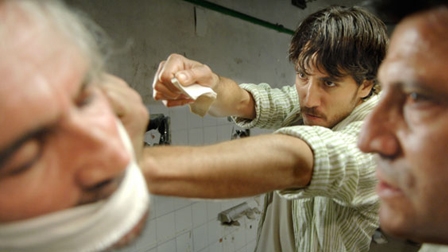
When the unconscious 33-year-old Juan Oliver (Alberto Ammann) finds himself being slapped back to reality in that very cell, he is quite oblivious of its morbid past. In fact, he is not supposed to be inside a prison cell in the first place. All he knows is that he has been employed as a guard at the Prison Central Provincial—a job he was supposed to join the day after. Leaving his wife, Elena (Marta Etura), who is six-months pregnant, at home, he had decided to pay his new employers a visit a day before his first working day, just to see ‘how things work’. He was being shown around by his two colleagues Armando and Germán, when an explosion occurred and he lost consciousness.

It does not take the groggy Juan too long to understand that he is in the middle of a nightmarish scenario—a riot, led by the raspy-voiced, bald-headed, life-sentence-serving Felipe Gonzalez, popularly referred to as Malamadre (slang for ‘bad mother’), has broken out. Before long, he is dragged in front of Malamadre (played impeccably by Luis Tosar). Juan realises, to his utter horror, that to survive, he has no other option but to win over the trust and confidence of Malamadre and his cronies by making them believe that he is one of them—a fellow inmate.

In a world where a handmade musket, built out of pipes and spring, is worse than its actual counterpart; where a spoon doubles up as a lethal weapon; and justice is often meted out with iron rods, Juan knows one false step, one wrong answer, one betraying expression could well be his very last. While thinking on his feet, he figures out that his only hope of seeing the outside of the prison walls is to keep his act together, and helping out the prison officials deal with the situation, at the same time.

As the prison warden Jose Roca and his colleagues wait for the SWAT team to arrive, the situation gets aggravated when Malamadre reveals his trump card in the negotiations that he will undertake with the officials. He takes three terrorists—members of the ETA, a Basque separatist organisation, who are holed up in the same prison but in an isolated ward—as hostage, threatening to kill them if his demands are not met. As the goings-on get more and more politicised, a federal envoy is sent in to negotiate, the SWAT team is kept on high alert, the local radio station breaks the news, TV coverage begins, and civilians start thronging the prison gates. Among the crowd is Elena.

Meanwhile, tension mounts within the prison walls. It becomes quite apparent to Juan that ensuring that the three ETA members are not endangered is more of a priority to the envoy than saving his life. With news of similar riots breaking out in other prisons filtering in, the negotiator reveals that giving in to Malamadre’s demands might not be possible for the simple fear of inciting the riots elsewhere. And Apache (portrayed by Carlos Bardem, older brother of Javier), a fellow Colombian inmate and the prison officials’ snitch, is growing more and more suspicious of who Juan really is.

Of all film genres, prison drama is, arguably, one of the most cliché-ridden. However, writer-director Daniel Monzón (who also wrote and directed the Hitchcockian suspense thriller The Kovak Box) has succeeded in steering clear of almost all the usual triteness in this riveting film. Instead of dishing out another story involving sadistic wardens, vicious guards, and impossibly ingenious escape plans, Monzón has opted to depict a subtle indictment of the prevailing Spanish incarceration policy—in particular, the Designated for Special Surveillance (DSS) part of it that is meant for ‘murderers, jail-breakers, and psychopaths’.

In Celda 211, Monzón has shown that the Spanish prison system, like most of its brethren the world over, is hampered by hierarchy, mired in bureaucracy, and burdened with political pressure. In a vital scene in the film, he voices how he believes convicts in Spanish prisons are treated, when Juan exclaims: ‘We’re trash, and what you do with trash is take it out before it stinks’.

While touching upon the core ideas of any film that deals with prison life, such as the process of dehumanisation of the convicts, defiance of inmates against inhumane treatment, and prisoners’ constant battle with authority, Celda 211 goes one step farther. It shows that the four walls of a prison cell is a law unto its own. Sometimes, an innocent man enters the space, albeit unwillingly, and gets transformed into a transgressor. 

Sunday, February 13, 2011

Just who are the monsters here?


‘We have learned now that we cannot regard this planet as being fenced in and a secure abiding place for Man; we can never anticipate the unseen good or evil that may come upon us suddenly out of space’. — H G Wells

This sentence, from Wells’ The War of the Worlds, published in 1898, has, since the 1950s, served as the template for a sub-genre of science fiction films—the alien-invasion movie. Notable examples include: The Day the Earth Stood Still (1951), It Came From Outer Space (1953), Invasion of the Body Snatchers (1956, remade in 1978, and re-remade as the inferior The Invasion in 2007), Earth versus Flying Saucers (1956), Independence Day and Mars Attacks (both in 1996), Men in Black (1997), Men in Black II (2002), and the superb District 9 (2009);  not to mention the attempts made at bringing that particular classic of Wells to the silver screen—the first in 1953 by Byron Haskin, and the next, an adaptation that came out 52 years later, helmed by a certain Steven Spielberg. The recently released Skyline (2010), and the upcoming Cowboys and Aliens (2011) starring the dynamic Ford-Craig duo and Battle: Los Angeles (2011)  make it apparent that screenwriters and directors are not yet ready to forsake this once-fertile sub-genre.

What is also common to almost all these aforementioned films is that in each case, the aliens seem to have a particular agenda—a hostile takeover of planet Earth. It seems we have all but forgotten that Wells had, in his writing also mentioned the words ‘unseen good’. It is true that Gareth Edwards’ Monsters (2010) does not delve into that particular aspect of an alien invasion; at the same time, it would not be incorrect to state that he has portrayed a scenario that makes the sub-genre almost come full-circle—back to The Man from Planet X (1951), where the visitor from outer space was not a belligerent foe but a benign extraterrestrial.

Six years prior to the incidents depicted in Monsters, we are told that NASA discovered alien life on Europa, one of Jupiter’s 63 moons. A deep-space probe was sent to Europa, which, however, crashed over Mexico during re-entry. Since then, new life forms have begun to appear in and around the area, so much so that half the country had to be quarantined as an ‘infected zone’. While the US and Mexican military are on continuous vigil against the ‘creatures’, a huge man-made wall has been erected at the US-Mexico border, while tall fences try to keep the tentacled aliens out of civilian-inhabited areas.

Our male protagonist, Andrew Kaulder (Scoot McNairy), is a photographer working for a magazine. Posted at San Jose, Central America, his intentions of following the story of his life suddenly faces a roadblock, when he is asked by his superior to take on a completely unrelated assignment—to escort the magazine’s owner’s daughter, Samantha (played by McNairy’s real-life spouse Whitney Able) to the US border. Thus begins a journey that will take the two of them through the dreaded ‘infected zone’.

The landscape is littered with evidences of large-scale destruction. Buildings have been turned into rubble, helicopters have crash landed by the road, an aircraft and a tank are seen sunk in water, and there are cars on trees. Curiously, amidst this bleak scenario, Sam and Andrew—as alien to each other as the creatures they fear might attack them anytime—start to drop their individual guard slowly but gradually, and begin to learn more about one another.

At the same time, they start gaining knowledge on the towering, tentacled tormentors. They are told by the group of armed men who are accompanying them to the US border that the creatures are amphibians—they stay mostly in water, crawl up to the land at times, and lay eggs in trees. They are also told that ‘If you don’t bother them, they don’t bother you’. Similar to the visitor from The Man from Planet X, who only turned violent after being confronted by an evil scientist, the creatures in Monsters are known to attack only when they are fired upon.

With a budget as low as $800,000 (some mention it to be even lower, at $500,000); a meagre three-week long shooting schedule; location shooting for the entirety of the film in Mexico, Guatemala, Costa Rica, and Texas; and while helming the quadruple responsibility of director, writer, production designer and special effects, the Brit Gareth Edwards has taken a route diametrically opposite to his American counterparts like Michael Bay. Just as Andrew and Sam, while standing at the US-Mexico border stare at the gargantuan wall and realise that there are not many occasions when Americans get an opportunity to look at their country ‘from the outside in’, Gareth, too, wonders at our penchant to shut out what we do not understand because we immediately reckon it to be threatening.

For those of us searching for it, there is an obvious political subtext to the film—that of immigration, but there are two other aspects that make this road movie nestled inside a sci-fi fascinating. One is that the aliens, unlike the overwhelming majority of their ilk that has been depicted on celluloid, are completely without an agenda. In fact, they are trying as hard as us to survive on this unfamiliar planet. And second is how the fact that the overarching theme that humans and the creatures are two life forms that seem to be unable to understand each other is reflected in the story of Andrew and Sam. They started off as strangers, and when they understood each other, they understood the ‘monsters’, too.

It is indeed an irony that we are sending signals to outer space in search of intelligent life forms, but have this penchant for shutting out anyone or anything that does not seem to conform to our preset notions, views, and perspectives. It is communication that broke the mental fence that Sam and Andrew had erected between themselves. But the US military did not follow suit, while dealing with the creatures. They opted to open fire instead, thereby vindicating the words of another doyen of science-fiction, Isaac Asimov, who had asserted in Foundation, ‘Violence is the last refuge of the incompetent.’

Sunday, February 6, 2011

A Truly Sweet Revenge


With the 83rd Oscars—the Academy of Motion Pictures and Sciences’ annual tentpole event—barely weeks from now, it will now be a decade since the edition remembered the most by majority of Indians. That was when Ashutosh Gowariker’s Lagaan failed to bowl out the rest of the competition in the ‘Best Foreign Film’ category. Equally disheartened across the globe that year, and since then, has been an ever-increasing number of cine-lovers, who just cannot fathom how Jean-Pierre Jeunet’s utterly charming Le fabuleux destin d’Amélie Poulain (aka Amelie) did not win enough hearts at the Academy to win the trophy in the same category.

A self-taught filmmaker, Jeunet belongs to a dying breed of directors—the ‘auteur’ (or author). A much-influential film theory that evolved in the 1950s in the seminal French film journal Cahiers du Cinéma, the auteur theory argues that just like authors use the pen to express themselves in literature; each film, too, should reflect its director’s own vision. One can view this as the filmic equivalent of expressionism in painting—with both putting emphasis on the creator’s (painter/filmmaker) subjective perspective.

The hallmark of an auteur is that it takes the viewer only a couple of moments to guess the director correctly, every time he/she views any instance from his/her body of work. In other words, an auteur leaves his/her signature behind in his/her films.

Jeunet’s signature is the way he digitally manipulates colour in every frame. Like a true auteur, he has stuck to his trademark visual aesthetic in his latest offering—Micmacs à tire-larigot (2009), which roughly translated into English, means ‘Non-stop shenanigans’.

Bazil (Dany Boon) is a thirty-something video store clerk, who can recite dialogue from films from memory. As a kid, he lost his father—a soldier—in Morocco to a landmine. While that particular weapon of war broke his heart, another product of arms manufacturers—the revolver—leaves behind a much more apparent scar. A stray bullet from a shootout that occurs right in front of his video store hits him right in the head and lands in his brain. Gauging that operating on Bazil might have fatal consequences; a surgeon decides to leave the bullet where it is.


Stripped off his job and ousted from his home, Bazil spends two months roaming the streets begging, till he meets Slammer, an ex-convict. Slammer, aware of the fact that the bullet could pop Bazil’s brain any second, tells him that he knows of a family who will still be willing to adopt him. Slammer introduces Bazil to a motley crew of individuals, who live in a junk yard. There’s Mama Chow—the cook, who is also in charge of recruiting; Calculator, a young girl capable of conducting complex mental calculations in an instant; Tiny Pete, who can create wondrous automatons using scrap metal; Remington, a former ethnographer from Congo, who speaks in old-world clichés; Elastic Girl, a contortionist; and Buster (played by Jeunet’s perennial favourite Dominique Pinon), a human cannonball. They spend their time salvaging defective stuff. No wonder then, they welcome Bazil.

One fine day, while collecting junk, Bazil realises, to his utter amazement, that the company that manufactured the landmine that blew his father into smithereens and the organisation that was behind the bullet that is now a ticking bomb in his brain, have their headquarters on opposite sides of the same street. Like Amelie, who decided to take matters in her own hands to teach the local vegetable vendor—who repeatedly ill-treated his dim-witted employee—a lesson; Bazil, does not get mad at the CEOs of the two companies. He, too, decides to get even, while being ably assisted by his family of six.

With the sombre topic of international arms dealing as the backdrop, and the morbid situation of the protagonist, who has lead in his head, Micmacs could easily have turned into a dark, brooding thriller. But similar to Jeunet’s characters, who never get bogged down by their circumstances, and his frames, which show the world in a different hue than usual, the film does a volte-face and takes on an amusing avatar. Akin to The Big Sleep (1946)—a film the adult Bazil was watching when we first see him on screen—which deals more with the process of a criminal investigation and ponders less on the results; Micmacs, too, is more about how the magnificent seven go about extracting revenge, than the final outcome.

It is obvious that like the protagonist of his latest film, Jeunet, too, is a movie aficionado. There are numerous references to other films strewn throughout Micmacs. Look out for Bazil begging inside a subway station, lip syncing to a female singer on the other side of a pillar, who is oblivious of his presence, in a direct homage to the Jean Hagen lip syncing to Debbie Reynolds sequence in Singin’ in the Rain (1952); the ode to Chaplin when an obviously hungry Bazil is restrained by his pride from approaching a woman, who is distributing food packets, and he feigns that he is waiting for a cab; the Buster Keaton-ish moment while cleaning windows and being caught snooping; the characters speaking about Scarface (1983) and Fiddler on the Roof (1971); the shot of Buster zooming through the air a la The Rocketeer (1991); the harking back to the famous Russian roulette sequence in The Deer Hunter (1978); split screens similar to De Palma’s Mission Impossible (1996); and at least two references to Once Upon a Time in the West (1968): a buzzing fly, and the way in which one CEO ends up on the shoulders of another in the same manner as Harmonica’s brother in Leon’s masterpiece. Not only that, in a particularly ingenious sequence, by using sound effects, Jeunet succeeds in fooling the two antagonists and the audience alike.

Other than the surreal tints, what brings Jeunet’s films alive is the quirkiness of his secondary characters. Micmacs, too, follows this tradition. So, we have a surgeon who flips a coin to decide whether to operate or not; a CEO who quotes poetry during his speeches; his rival, whose collection includes Marilyn Monroe’s molar and Churchill’s nail clippings; a security personnel, who has worn the same sweater for three decades…and the list goes on.

The only other filmmaker of this generation who is successfully delving in fantasy is the Spanish auteur Guillermo Del Toro (of Pan’s Labyrinth fame). However,
while Del Toro focuses on bringing out the macabre side, Jeunet highlights the  magical in the mundane.

Possibly, the most apt way to apprise Jeunet’s body of work is indicated by Elastic Girl during a conversation with Bazil. While Bazil dismisses her as ‘twisted’, she begs to differ. She exclaims, in return that she is just a ‘sensitive soul in a flexible body’. 

Sunday, January 30, 2011

A Master class in Minimalism


Taphephobia (from Greek taphos, meaning grave; and phobos, meaning fear) is the medical term for the fear of being buried alive. Those of us who have read the master of macabre Poe’s The Fall of the House of Usher, The Cask of Amontillado or the self-explanatory The Premature Burial would have had a second-hand experience of this terrifying situation. But in Spanish director Rodrigo Cortés’ single-character, single-setting, tour de force, Buried (2010), for Paul Conroy (Ryan Reynolds), the prospect of being buried alive is not a crooked literary concept, but almost a cruel certainty.

One day in October 2006, Paul wakes up in complete darkness. All he could remember was that he, alongside his other truck-driver friends—all of who work for Crestin, Roland, and Thomas (CRT), an American company—were ambushed while delivering kitchen supplies. While Paul was fortunate enough to escape the gunfire—to which most of his companions succumbed to—after he regains consciousness, he finds his current situation anything but lucky.


Paul finds himself gagged and bound inside a wooden coffin, just large enough to accommodate enough oxygen to keep him alive, with absolutely no clue of who put him there, and why—a predicament reminiscent of Oh Dae-su in Korean filmmaker Chan-wook Park’s masterpiece Oldboy.  While Dae-su had been imprisoned by unknown assailants in a room for 15-long years with only a television as his link to the outside world, Conroy finds that his kidnappers had left him behind a Blackberry, a Zippo, a pen, a flask, his medicines, a torch, his wallet (emptied), and a satchel.

After he realises that his cries for help are falling into deaf ears, Paul, with the help of his Blackberry, tries to figure out a way to wriggle out of his nightmarish situation. As any American would do in a similar situation, his first call is to 911. But since he is in a different country, he finds little help from that source. So, he calls the FBI next. And thus begins his earnest quest to get outside help, any help.

In the meantime, someone calls him and tells him in broken English that he has till 9pm to arrange for $5 million as ransom. With the phone’s battery, and the oxygen inside the coffin running out as fast as his own life, the stakes just got higher for Paul. After all, he is only a truck driver. Even though he had, somehow, conveyed his ‘situation’ to the US Department of State, and to his own company, what were the chances they would find him, when he, himself, has not even the foggiest idea of where exactly in Iraq he has been buried underground?

An individual trapped in an apparent hopeless situation is an age-old trope in cinema. However, what elevates Buried from others belonging to the same genre is the treatment. For the entire 95-minutes’ running time, the camera does not emerge, even for a second, on to the surface, thereby making us, the viewer, very much a part of Paul’s claustrophobic existence. Reminiscent of Kubrick’s experimentation with only natural light in Barry Lyndon (1975), the only source of light in the film are the ones that Paul uses—a blue mobile screen, the yellow flame of the Zippo and the torch, and the eerie green of glow torches.

Just like the letterings of the opening credits that break apart and bubble up, and the geometric lines that obstinately move down to form the first letters of the various crew members, Paul’s efforts at emerging out of the wooden casket seem to be bogged down by forces way beyond his control.

Like any other human being in his place, Paul undergoes an entire gamut of expressions—fear, anger, panic, frustration, hope, and despair. As an individual who has a history of anxiety attacks, Paul knows that his biggest ally and his biggest enemy are one and the same—himself. He gathers his wits, just when things appear to be hopeless, and tries to make the best of the meagre resources at his disposal.

Let’s face it, we have seen drivers emerging out of similar no-way-out scenarios unscathed (here’s looking at you, Jason Statham), but Paul is no superhero (ironically, though in his next film Ryan Reynolds will play a superhero, the Green Lantern). So, as he waits for the head of the Hostage Working Group (HWG) in Iraq to locate him by tracking his cell connection, he takes resort to his survival instinct to stay alive till the rescuers arrive. But, things are about to get worse for Paul.

Cortés’, who alongside directing, has also edited this edge-of-the-seat thriller, while staying true to a Hollywood-set template has steered clear of clichés. For instance, there are no villains of the piece. The film does not take sides. We learn from the head of the HWG that in a country torn apart by war, kidnapping is the ‘only functioning business’. (There is a wonderful tête-à-tête between the captive and the captor, when the latter exclaims: ‘You terrified? So, I am a terrorist?’)

What makes Paul’s experience equally harrowing for us, the viewer, is the fact that just like him, we only get to hear the people he speaks with over the phone. Just like him, we have to take their words at face value. Just like him, we do not get to see what the FBI or the HWG are doing to get Paul out.

A solo character, single-setting film is a unique challenge. No wonder then, such films have been few and far between—the few examples include Daniel Bourla’s astonishing The Noah (1975), Robert Altman’s seminal Secret Honor (1984), the recent Sam Rockwell starrer Moon (2009), and this year’s Oscar-nominated 127 hours by Danny Boyle.

What makes Buried by the 37-year old Cortés out-of-the-box is that he decided to film it in-the-box—in its entirety.

Sunday, January 9, 2011

A Mother, Murder, and Memories

In a pivotal moment in Korean filmmaker Joon-ho Bong’s recent film, the superb Madeo (2009), a police officer, while referring to the forensic team collecting evidence at a murder scene, tells his colleague “Cops these days…CSI and all that TV!”

While serials like the aforementioned CSI and its various spin-offs focus on the science behind solving terrible crimes, it is films like Madeo (Mother) that, in contrast, have at their heart the dynamics of the individuals involved therein—the victim, the accused, and their friends and family.

The eponymous Mother (she is not mentioned by her name throughout the film’s 128-minute duration), played impeccably by Hye-ja Kim, lives a forlorn life in a town in the outskirts of Seoul with her intellectually challenged son Yoon Do-joon. She tries to make both ends meet by selling herbs and medicines and by providing acupuncture sessions to the neighbours, though she does not have a valid licence to ply that particular trade.

Mother treats Do-joon as a child, helping him eat, asking him to tuck in his shirt, and advising him not to mix with his friend Jin-tae, who she considers as ‘bad seed’. Knowing that they have ‘only got each other’, she shares an exceptionally strong bond with her son, who besides lacking in intellectual capacity also has problems remembering things. A harmless and gullible guy, who is as innocent of the nitty-gritty of life as he is of the man-woman equation, the only time Do-joon reacts violently is when anyone calls him a ‘retard’.

The occasional visit to the neighbourhood police station—where the guards and the higher officials are all known to Mother from their childhood—when her son gets involved in minor scuffles, takes a turn for the worst when Do-joon is taken into custody by officer Je-mun as the prime suspect in the murder of a young girl Moon Ah-jung. Knowing fully well that her son cannot ‘even harm a water-bug’, Mother starts running from pillar to post—trying to bribe Je-mun with camphor ginseng (‘which helped you when you were a child’) and getting hold of the most well-known public defender of the area, the karaoke-loving Gong Suk-ho, to prove her son’s innocence. But when she finds herself shunned by the police, who have an incriminating piece of evidence at their disposal that links Do-joon directly to the crime; and betrayed by the lawyer, who suggests sending Do-joon away to a mental asylum for four years, Mother takes it upon herself to acquit her son. She starts collecting evidence, distributing pamphlets proclaiming her son’s innocence, and starts talking to kids who knew Moon Ah-jung, who, she finds during her investigations was quite opposite to her own son—being a girl who grew up far beyond her chronological age. In her quest, she finds two allies—a neigbour who runs a photo studio and Jin-tae, Do-joon’s friend.

Her efforts at trying to make Do-joon remember the incidents of the fateful night face a curious resistance. In trying to remember, Do-joon inadvertently unlocks various suppressed memories that rather than helping mother find a ray of hope, makes her come face to face with incidents in her and Do-joon’s lives that she never thought he would recollect.

In the same manner, as Mother proceeds in her search for truth, dark secrets of the small town—a town that had not seen a murder in years—start rising to the surface, till we reach a dénouement that throws both Mother and we, the viewer, off-balance.

Joon-ho Bong, alongside Chan-wook Park (of Oldboy and Thirst fame), belongs to an exciting generation of Korean directors, who have ushered in a new era of filmmaking. Bong made quite a splash in Hollywood with his 2006 creature feature Gwoemul (The Host). However, the film with which one can draw parallels with his most-recent work is his film of 2003, Salinui chueok (Memories of murder). In that film, two police officers, one from a small town and the other from the city try to solve a series of grisly killings in the South Korean province of Gyunggi. In both the films, the peace and quite of a small town are ruptured by violent crime. In both cases, a mentally-challenged individual is accused of the misdeed. In both instances, though the cases were apparently solved, one character was found to be carrying the burden of truth for the rest of their lives.

In the course of Madeo, Mother asserts twice that she, and only she, knows of an acupuncture technique that when applied to ‘the meridian point’ can ‘loosen the knots in the heart and clear all horrible memories from the mind’. In the climax of the film, which harks back to the conclusion of Oldboy, Mother found out that the same acupuncture needles that she claims can have such a therapeutic effect, can also be the harbinger of unimaginable pain. 

Tuesday, December 21, 2010

When Words Fail to Deliver

O' Henry, one of the most prolific and celebrated short story writers of all time gained entrance into the glitzy world of Bollywood, courtesy Rituparno Ghosh's maiden Hindi directorial venture Raincoat (2004).

Based on one of the master's most popular short stories, 'Gift of the Magi', Raincoat deals primarily with two characters—Manu (Ajay Devgan) and Neeru (Aishwarya Rai). Once engaged, now estranged, they meet after a long period of separation at a time when both are undergoing emotional crises.

 What emerges is a tête-à-tête that lasts for the major part of an afternoon and the lion's share of the 117-minute running time of the film.

 A curtain of rain separates the couple from the rest of the world. Confined within the four walls of a room in a house in south Calcutta, they embark on a 'game of words'. Careful not to pry or delve deep into each other's lives, they find that although time has eroded their passion, an ember still glows deep within their hearts.

The film encapsulates the maxim that true love is all about selflessness, sacrifice, and sentiment. It is also about putting on a façade. That is precisely where the implication of the eponymous raincoat comes in.

Protected from the torrential rain, Manu enters the now married Neeru's world wearing a raincoat. He takes it off after he enters her home, but soon finds out that he has to wear a garb to face the harsh realities that stare him in the eye. Neeru realizes the same. The film is all about the mental makeup that we put on when faced with a reality that makes the heart grow fonder about the dreams that one once cherished and wished would one day be realized.

In the consumerist society we live in, the kind of emotion that Manu and Neeru have for each other is antiquated, and is amplified by the mise-en-scène of the room, filled with old clocks, ancient furniture, and similar bric-a-brac. It is as if both the characters are in a time warp, lamenting a past that they treasure, and a future that is as bleak as the weather outside.

It is a story-within-a-story format that Ghosh has implemented, but with little success. Considered by many as the best screenplay writer to have emerged from Bengal after Satyajit Ray, this is precisely where Ghosh falters in this venture. For a film that is solely dependent on dialogues, this is one department where Raincoat fails miserably. 

What could have emerged as an illustration of connotation is ultimately relegated to banality that at times precariously teeters on the verge of being branded inane. The spine of a screenplay is conflict, creation of tension, which keeps the viewer engrossed in the goings-on—aspects that are conspicuous by their absence in Raincoat.

With the single room setting a la Hitchcock's Rope, two-character interaction reminiscent of Gus Van Sant's  Gerry, Raincoat had a lot of potential in it. Deft art direction, mellifluous melodies—which, for once, do not hinder the progress of the film—and able performances by the two protagonists make one feel even sadder for the opportunity that has gone a-begging. 

One emerges out of the theatre after watching the film imagining what it could have been, rather than what it actually is. Add to all this a poster of Sophia Loren that the camera lingers on for quite sometime brings to one's mind Vittorio de Sica's Sunflower starring the legendary actress—a film that dealt similarly with unrequited love, but succeeded in eliciting a sigh of despair in a context diametrically opposite to that of Raincoat!

Watered Down Nationalism


What's the similarity between Sam Mendes, Farhan Akhtar, and Ashutosh Gowariker; apart from the fact that they are all acclaimed filmmakers of the current generation? Apparently, there is none, except the fact that all three made a film (debut in the cases of Mendes and Farhan, and Ashutosh’s fourth after Pehla Nasha, Izzat ki Roti, and Baazi) that wooed critics and the masses alike. The films were all box-office successes, swept the awards they were nominated for, and the trio faced the same expectations when they announced their next film. Add to this the fact that their second film was as different from the first as one could ever think of.

Swades (2004), much touted as Ashutosh Gowariker's second inning after Lagaan, holds on its own. In fact, in certain respects it is a much better film than the 2001 mega-success. True, it has its similarities with its predecessor, but it’s like a novelist using the same words in a different context and emerging with a totally different connotation to them.

It is said that to bring out the effect of light, one needs to know darkness. This basic contrast is used as a backbone in Swades. What can be more apt to bring out the fact of being rooted to reality than some one who as a profession aims for the sky? Mohan Bhargava (Shahrukh Khan) is a Project Manager at NASA working on Global Precipitation Measurement—a technology that takes the guesswork away from forecasting rainfall.

This is the beginning of the recurrent water motif that Gowariker has so masterfully utilized in his film. From the affinity of Mohan to mineral water (one bottle of which he gifts to a minstrel who he picks up on his caravan); to a child water vendor who acts as a catalyst in the protagonist's life; the singular channel of change in a village; the ultimate ablution in a water body where Mohan washes his soiled feet; to Geeta's (Gayatri Joshi) first question to Mohan in a classroom about five rivers of India—the source of life acts as a refrain throughout the film.

Other deftly applied symbolisms abound, especially remarkable is one where Gowariker, the director, removes a great class divide in a village—an erected movie screen—to bring to the fore what the film stands for: a coming together, a unison.

The performances are also remarkable. Kishori Ballal as Kaveri Amma, the mother figure who brought up Mohan, is simply sublime. Gowariker should be applauded for eliciting touching performances from non-actors—a despondent farmer who has all but given up hope of providing for his family; an aged woman whose only reaction to her first interaction with a lit bulb is simply uttering the word 'bijli'...the instances are many.

Gowariker's forte, apart from being a brilliant storyteller, has been his character sketches, a trait that is evident in this offering as well. The film brings to light Shahrukh Khan as never seen before—a cliché that is actually applicable as far as his portrayal of Mohan Bhargava is concerned.

Considered a demi-god, Khan sinks into his character albeit a trifle skeptically at the beginning of the movie, but then settles into it in the same manner he dips his feet in the murky water of the village reservoir. Unfortunately, the same cannot be said of the debutante Gayatri Joshi. While seeing her acting prim and proper, I could not but help wonder if her character was written with Nandita Das lurking somewhere at the back of the mind of the screenplay writer!

Swades is as patriotic in flavor as any release in the same genre, with a subtle difference. Except for two sequences, it makes its statement without resorting to any sort of jingoism.

Look for the brilliant quirks in the film—the reaction of an eight-year old to a huge caravan in a village, a water pipe turning into a musical instrument, an inverted image of a temple as seen through the eyes of a child looking at it in an upside-down manner—these are the small things that ultimately separate the wheat from the chaff and not an elaborately staged, grandiose item number.